الإدراك والتوليدintermediateمعالج رسوميات~25 دقيقةColab
ازرع اختصاراً واضبط النموذج متلبّساً
Plant a Shortcut, Catch the Model
الدقة تقيس اتفاق النموذج مع التسميات، لا سبب هذا الاتفاق
يسلّمك زميلٌ مصنِّفاً يميّز القطط من الكلاب، ودقّته على بيانات الاختبار ممتازة. لا شيء يدعوك إلى الشك فيه، وهنا بالضبط تكمن المشكلة. فبيانات الاختبار جُمعت بالطريقة نفسها التي جُمعت بها بيانات التدريب، ولذلك تحمل كلَّ مصادفات تلك الطريقة. في هذه الورشة تصنع مصادفةً كهذه عن قصد: مربّعاً ملوّناً صغيراً، أقلّ من واحد بالمئة من مساحة الصورة، نضعه على معظم الكلاب وعلى قلّة من القطط. ثم ندرّب شبكتين متطابقتين على الصور نفسها، إحداهما ترى المربّع والأخرى لا تراه. على بيانات الاختبار المعتادة تتفوّق الشبكة التي رأت المربّع بفارق 0.079 في الدقة. لكن اعكس توزيع المربّع، فتهبط الشبكة نفسها إلى 0.086، أي أسوأ من رمي قطعة نقود. بعد ذلك يُريك Grad-CAM أين كانت تنظر.
الهدف
درِّب نموذجاً نزيهاً يميّز القطط من الكلاب فعلاً. ثم أثبت أن دقة نموذج الاختصار تنهار حين يكفّ المربّع عن موافقة التسمية. وأخيراً استخدم <bdi dir="ltr">Grad-CAM</bdi> لتُظهر أن قرار هذا النموذج يعتمد على المربّع أكثر بكثير مما يعتمد عليه النموذج النزيه.
يفتح Colab نسخة للقراءة فقط. احفظ نسخة في Drive للاحتفاظ بتعديلاتك.
يحتاج الدفتر إلى لوحة مفاتيح — يُفضَّل فتحه على حاسوب مكتبي.
الأوراق وراء هذه الورشة
تجيب عن سؤال واحد: هل يتفق النموذج مع التسميات على أمثلة لم يرها من قبل؟ لكنها لا تجيب عن سؤال «لماذا».
افترض أن صور التدريب وصور الاختبار جُمعت بالطريقة نفسها. عندها تنتقل أيّ مصادفة في طريقة الجمع إلى المجموعتين معاً: علامة مائية، أو خلفية متكرّرة، أو كاميرا بعينها. والنموذج الذي تعلّم المصادفة سيحصل على الدرجة نفسها التي يحصل عليها نموذجٌ تعلّم الشيء المقصود.
هذا ما نسمّيه . ويصعب أن تلاحظه من الخارج، لأن شيئاً لا يتعطّل. النصيحة المعتادة هي أن تشكّ في بياناتك، وهي نصيحة يسهل أن توافق عليها ويسهل أن تنساها. لذلك لن نقرأ عن الاختصار هنا. سنبنيه بأيدينا، ونقيس أثره في الأرقام، ثم ننظر داخل النموذج لنراه وهو يستخدمه.
تأكّد أن بصمة الشيفرة تطابق الدفتر، وأن وحدة GPU متّصلة.
import azimuth_nb as azimuth

env = azimuth.setup(SLUG, lang=LANG, profile=PROFILE)ازرع اختصاراً واضبط النموذج متلبّساً
Tesla T4 · 14.6 غ.ب · ذاكرة 12.7 غ.ب · PyTorch 2.11.0+cu130
الملف: free
البيانات:
· cifar-10-python.tar.gz — 166,502 KB, UNPINNED
جاهز · seed=17, epochs=20, batch_size=256, lr=0.003, width=32, patch_px=3, shortcut_rate=0.95
الشيفرة · 93bb602420424303في النسخة العربية يجب أن يظهر هنا اسم خطّ Noto عربي. إن لم يظهر، فستُرسم نصوص الرسوم مربّعات فارغة.
# matplotlib draws Arabic as isolated letters in logical order, so the Arabic
# build reshapes every label and draws it with a font that has Arabic glyphs.
# DejaVu, matplotlib's default, has none.
import glob

import arabic_reshaper
import matplotlib.pyplot as plt
from bidi.algorithm import get_display
from matplotlib import font_manager

ARABIC_FONTS = ("NotoNaskhArabic-Regular.ttf", "NotoSansArabic-Regular.ttf")
font_path = next(
    (p for name in ARABIC_FONTS for p in glob.glob(f"/usr/share/fonts/**/{name}", recursive=True)),
    None,
)
if font_path:
    font_manager.fontManager.addfont(font_path)
    arabic_family = font_manager.FontProperties(fname=font_path).get_name()
    plt.rcParams["font.family"] = [arabic_family, "DejaVu Sans"]
elif env.lang == "ar":
    print("⚠ لم يُعثر على خطّ عربي؛ ستظهر النصوص العربية في الرسوم مربّعات فارغة.")


def label(en_text, ar_text):
    """Pick the string for this build; shape Arabic so matplotlib draws it joined."""
    if env.lang == "ar":
        return get_display(arabic_reshaper.reshape(ar_text))
    return en_text


if env.lang == "ar":
    print(f"خطّ الرسوم: {font_path or 'غير متوفّر'}")
else:
print(f"figure font: {font_path or 'default'}")خطّ الرسوم: /usr/share/fonts/truetype/noto/NotoNaskhArabic-Regular.ttfنأخذ من CIFAR-10 فئتين فقط: القطط والكلاب. وهما الزوج الذي تخلط بينه الشبكات الصغيرة أكثر من أيّ زوج آخر، فالحجم متقارب والفرو متشابه، والوضعيات متشابهة في صورة من 32 في 32 بكسلاً.
لهذا الاختيار سبب. يكون الاختصار أكثر إغراءً حين تكون المهمة الحقيقية صعبة. فالإشارة الرخيصة تُنزل الخسارة أسرع مما تفعله الخصائص الحقيقية، والتدريب يتبع ما يُنزل الخسارة أسرع.
نبحث عن الفئتين باسميهما في بيانات الأرشيف الوصفية، لا بموقعهما. ويجب أن تكون نسبة الكلاب قريبة من النصف.
# CIFAR-10 ships as pickled batches inside one tarball. We read only two
# classes, and we find them by NAME from the archive's own metadata rather than
# trusting that cat is index 3 — an index is a property of whoever exported
# the file.
import pickle
import tarfile

import numpy as np
import torch

torch.manual_seed(env.cfg["seed"])
np.random.seed(env.cfg["seed"])
device = "cuda" if torch.cuda.is_available() else "cpu"


def read_member(tar, suffix):
    member = next(m for m in tar.getmembers() if m.name.endswith(suffix))
    return pickle.load(tar.extractfile(member), encoding="latin1")


with tarfile.open(env.assets["cifar-10-python.tar.gz"], "r:gz") as tar:
    names = read_member(tar, "batches.meta")["label_names"]
    cat_id, dog_id = names.index("cat"), names.index("dog")

    def two_classes(batches):
        xs, ys = [], []
        for b in batches:
            raw = read_member(tar, b)
            labels = np.array(raw["labels"])
            keep = (labels == cat_id) | (labels == dog_id)
            xs.append(raw["data"][keep])
            ys.append((labels[keep] == dog_id).astype(np.int64))  # cat=0, dog=1
        x = np.concatenate(xs).reshape(-1, 3, 32, 32)
        return torch.from_numpy(x), torch.from_numpy(np.concatenate(ys))

    x_train, y_train = two_classes([f"data_batch_{i}" for i in range(1, 6)])
    x_test, y_test = two_classes(["test_batch"])

# Keep the uint8 images on the device; batches are converted on the fly.
x_train, y_train = x_train.to(device), y_train.to(device)
x_test, y_test = x_test.to(device), y_test.to(device)

n_train, n_test = len(y_train), len(y_test)
dog_share = round(float(y_train.float().mean()), 3)

if env.lang == "ar":
    print(f"صور التدريب: {n_train}   صور الاختبار: {n_test}   نسبة الكلاب: {dog_share}")
else:
print(f"train images: {n_train} test images: {n_test} dog share: {dog_share}")صور التدريب: 10000 صور الاختبار: 2000 نسبة الكلاب: 0.5الاختصار مربّع صغير بلون أرجواني في الزاوية السفلى اليمنى من الصورة.
لا نضعه على كلّ كلب، ولا نمنعه عن كلّ قطة. يحمله الكلب باحتمال معيّن، وتحمله القطة بالاحتمال المكمّل. النتيجة : قويّ لكنه ليس تاماً، وهكذا تكون الارتباطات الزائفة في البيانات الحقيقية.
ولهذا أمثلة مألوفة. قد يرتبط طراز جهاز التصوير في مستشفى ما بالتشخيص، وقد ترتبط العلامة المائية لمصوّر ما بموضوع صوره. لا طراز الجهاز ولا العلامة المائية هو ما نريد تصنيفه.
نضع المربّع بعد توسيع البيانات، فلا يتحرّك من مكانه أبداً. ونحدّد أيّ الصور تحمله مرة واحدة، ببذرة ثابتة، فيرى النموذجان التاليان صور التدريب نفسها تماماً.
انظر إلى الشبكة قبل أن تقرأ الأرقام. هل كنت ستلاحظ المربّع لو لم يخبرك أحد بوجوده؟
# The shortcut: a small solid square in the bottom-right corner.
#
# In training, a dog carries it with probability `shortcut_rate` and a cat with
# probability 1 - shortcut_rate. At 0.5 the square says nothing about the
# label; at 0.95 it is a near-perfect cue.
#
# The flags are drawn ONCE with a fixed generator, so every model below trains
# on byte-identical inputs.
PATCH = env.cfg["patch_px"]
PATCH_RGB = torch.tensor([255, 0, 255], dtype=torch.uint8, device=device).view(3, 1, 1)


def draw_flags(labels, rate_for_dogs, gen):
    """Per-image True/False: does this image carry the square?"""
    p = torch.where(labels == 1, rate_for_dogs, 1.0 - rate_for_dogs)
    return torch.rand(len(labels), generator=gen).to(labels.device) < p


def paint(images, flags):
    """Stamp the square onto the flagged images. Works on uint8 or float batches."""
    out = images.clone()
    if flags.any():
        patch = PATCH_RGB.to(out.dtype) if out.dtype == torch.uint8 else PATCH_RGB.float() / 255.0
        out[flags, :, -PATCH:, -PATCH:] = patch
    return out


gen = torch.Generator().manual_seed(env.cfg["seed"])
rate = env.cfg["shortcut_rate"]
train_flags = draw_flags(y_train, rate, gen)

# Three test sets built from the SAME test photos. Only the square moves.
test_sets = {
    "matched": paint(x_test, draw_flags(y_test, rate, gen)),  # same rule as training
    "clean": x_test.clone(),  # no square at all
    "flipped": paint(x_test, draw_flags(y_test, 1.0 - rate, gen)),  # the rule reversed
}

patch_pixel_share = round(PATCH * PATCH / (32 * 32), 4)
dogs_with_patch = round(float(train_flags[y_train == 1].float().mean()), 3)
cats_with_patch = round(float(train_flags[y_train == 0].float().mean()), 3)

# Show what a learner would see if they actually looked at the training data.
gallery = paint(x_train[:16], train_flags[:16]).cpu()
fig, axes = plt.subplots(2, 8, figsize=(11, 3.2))
for ax, img, y, f in zip(axes.flat, gallery, y_train[:16].cpu(), train_flags[:16].cpu()):
    ax.imshow(img.permute(1, 2, 0).numpy(), interpolation="nearest")
    ax.set_title(
        label("dog" if y else "cat", "كلب" if y else "قطة") + (" ■" if f else ""), fontsize=9
    )
    ax.axis("off")
fig.suptitle(
    label("Training images (■ = carries the square)", "صور من بيانات التدريب (■ = تحمل المربّع)")
)
plt.tight_layout()
plt.show()

if env.lang == "ar":
    print(f"المربّع يغطّي {patch_pixel_share:.2%} من بكسلات الصورة")
    print(f"كلاب تحمله: {dogs_with_patch:.1%}   قطط تحمله: {cats_with_patch:.1%}")
else:
    print(f"the square covers {patch_pixel_share:.2%} of the pixels")
    print(f"dogs carrying it: {dogs_with_patch:.1%}   cats carrying it: {cats_with_patch:.1%}")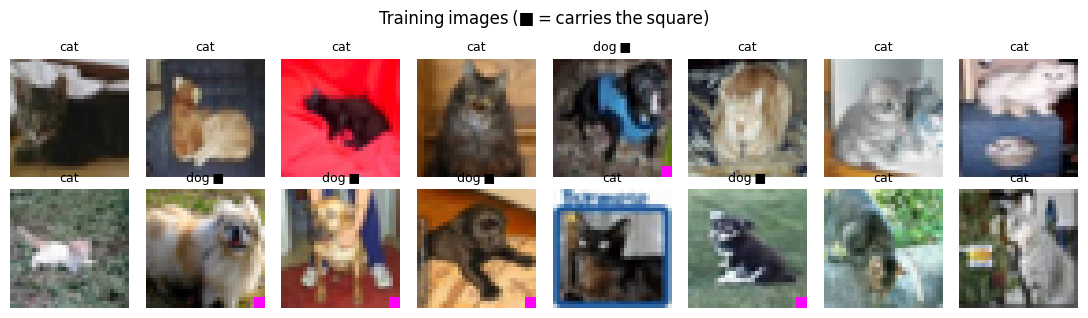
المربّع يغطّي 0.88% من بكسلات الصورة
كلاب تحمله: 95.6% قطط تحمله: 5.2%لاحظ المرحلة الأخيرة: خريطة خصائص من 8 في 8. هذه الخريطة هي ما سيقرؤه Grad-CAM لاحقاً، وكلّ خلية فيها تغطّي رقعة من 4 في 4 بكسلات من الصورة.
# A small ResNet: three stages of residual blocks at 32, 16 and 8 pixels.
# The last stage's 8x8 feature map is what Grad-CAM will read later.
import torch.nn as nn
import torch.nn.functional as F

MEAN = torch.tensor([0.491, 0.482, 0.447], device=device).view(1, 3, 1, 1)
STD = torch.tensor([0.247, 0.243, 0.262], device=device).view(1, 3, 1, 1)


class Block(nn.Module):
    def __init__(self, c_in, c_out, stride):
        super().__init__()
        self.conv1 = nn.Conv2d(c_in, c_out, 3, stride, 1, bias=False)
        self.bn1 = nn.BatchNorm2d(c_out)
        self.conv2 = nn.Conv2d(c_out, c_out, 3, 1, 1, bias=False)
        self.bn2 = nn.BatchNorm2d(c_out)
        self.skip = nn.Sequential()
        if stride != 1 or c_in != c_out:
            self.skip = nn.Sequential(
                nn.Conv2d(c_in, c_out, 1, stride, bias=False), nn.BatchNorm2d(c_out)
            )

    def forward(self, x):
        h = F.relu(self.bn1(self.conv1(x)))
        return F.relu(self.bn2(self.conv2(h)) + self.skip(x))


class SmallResNet(nn.Module):
    def __init__(self, width):
        super().__init__()
        w = width
        self.stem = nn.Sequential(
            nn.Conv2d(3, w, 3, 1, 1, bias=False), nn.BatchNorm2d(w), nn.ReLU()
        )
        self.stage1 = nn.Sequential(Block(w, w, 1), Block(w, w, 1))
        self.stage2 = nn.Sequential(Block(w, 2 * w, 2), Block(2 * w, 2 * w, 1))
        self.stage3 = nn.Sequential(Block(2 * w, 4 * w, 2), Block(4 * w, 4 * w, 1))
        self.head = nn.Linear(4 * w, 2)

    def features(self, x):
        return self.stage3(self.stage2(self.stage1(self.stem(x))))

    def forward(self, x):
        return self.head(self.features(x).mean(dim=(2, 3)))


def to_input(batch_u8):
    return (batch_u8.float() / 255.0 - MEAN) / STD


def augment(batch_u8, gen):
    """Random horizontal flip per image, random 4-px shift per batch. The square
    is stamped AFTER this, so it always sits in the same corner — as a real
    watermark would."""
    flip = (torch.rand(len(batch_u8), generator=gen) < 0.5).to(batch_u8.device)
    out = batch_u8.clone()
    out[flip] = out[flip].flip(-1)
    padded = F.pad(out, (4, 4, 4, 4))
    dx, dy = torch.randint(0, 9, (2,), generator=gen).tolist()
    return padded[:, :, dy : dy + 32, dx : dx + 32]


def train(flags, run_seed, epochs, tag):
    """Train a fresh model. Same seed -> same init and same batch order, so two
    runs differ ONLY in which images carry the square."""
    torch.manual_seed(run_seed)
    gen = torch.Generator().manual_seed(run_seed)
    model = SmallResNet(env.cfg["width"]).to(device)
    opt = torch.optim.AdamW(model.parameters(), lr=env.cfg["lr"], weight_decay=5e-4)
    bs = env.cfg["batch_size"]
    steps = epochs * ((n_train + bs - 1) // bs)
    sched = torch.optim.lr_scheduler.OneCycleLR(opt, max_lr=env.cfg["lr"], total_steps=steps)
    for epoch in range(epochs):
        model.train()
        order = torch.randperm(n_train, generator=gen).to(device)
        total, correct = 0.0, 0
        for i in range(0, n_train, bs):
            idx = order[i : i + bs]
            xb = paint(augment(x_train[idx], gen), flags[idx])
            logits = model(to_input(xb))
            loss = F.cross_entropy(logits, y_train[idx])
            opt.zero_grad(set_to_none=True)
            loss.backward()
            opt.step()
            sched.step()
            total += loss.item() * len(idx)
            correct += (logits.argmax(1) == y_train[idx]).sum().item()
        if epoch == 0 or (epoch + 1) % 5 == 0 or epoch + 1 == epochs:
            if env.lang == "ar":
                print(
                    f"[{tag}] الحقبة {epoch + 1:>2}  الخسارة {total / n_train:.3f}  دقة التدريب {correct / n_train:.3f}"
                )
            else:
                print(
                    f"[{tag}] epoch {epoch + 1:>2}  loss {total / n_train:.3f}  train acc {correct / n_train:.3f}"
                )
    return model.eval()


@torch.no_grad()
def accuracy(model, images_u8):
    hits = 0
    for i in range(0, len(images_u8), 500):
        hits += (
            (model(to_input(images_u8[i : i + 500])).argmax(1) == y_test[i : i + 500]).sum().item()
        )
return hits / len(images_u8)يبدأ النموذجان من الأوزان الابتدائية نفسها، ويريان الدفعات نفسها بالترتيب نفسه، ويتدرّبان العدد نفسه من الحقب. الفرق الوحيد بينهما هو وجود المربّع أو غيابه.
هذا الضبط هو ما يجعل المقارنة ذات معنى. فأيّ فرق يظهر في نتائجهما لاحقاً سببه المربّع، ولا شيء غيره.
هذا النموذج هو مرجع المقارنة. إن كانت دقته على الصور النظيفة منخفضة، فلا معنى للمقارنة التي تليه.
# The honest model: same photos, same schedule, no square anywhere.
no_flags = torch.zeros_like(train_flags)
honest = train(no_flags, env.cfg["seed"], env.cfg["epochs"], "honest")
honest_clean_acc = round(accuracy(honest, test_sets["clean"]), 4)

if env.lang == "ar":
    print(f"\nدقة النموذج النزيه على صور اختبار نظيفة: {honest_clean_acc:.3f}")
else:
print(f"\nhonest model, clean test images: {honest_clean_acc:.3f}")[honest] الحقبة 1 الخسارة 0.673 دقة التدريب 0.578
[honest] الحقبة 5 الخسارة 0.548 دقة التدريب 0.718
[honest] الحقبة 10 الخسارة 0.394 دقة التدريب 0.822
[honest] الحقبة 15 الخسارة 0.317 دقة التدريب 0.859
[honest] الحقبة 20 الخسارة 0.251 دقة التدريب 0.895
دقة النموذج النزيه على صور اختبار نظيفة: 0.868راقب سرعة ارتفاع دقة التدريب لديه مقارنةً بالنموذج النزيه. ثم اقرأ مقارنة الاختبار المطابق كما يقرؤها مراجعٌ لا يعرف شيئاً عن المربّع.
# The shortcut model: identical in every way except the square.
shortcut = train(train_flags, env.cfg["seed"], env.cfg["epochs"], "shortcut")
shortcut_matched_acc = round(accuracy(shortcut, test_sets["matched"]), 4)
honest_matched_acc = round(accuracy(honest, test_sets["matched"]), 4)
leaderboard_gap = round(shortcut_matched_acc - honest_matched_acc, 4)

# This is the comparison a normal workflow makes: a held-out split drawn from
# the same pipeline as the training data.
if env.lang == "ar":
    print("\nاختبار من نفس مصدر بيانات التدريب:")
    print(f"  النموذج النزيه   {honest_matched_acc:.3f}")
    print(f"  نموذج الاختصار   {shortcut_matched_acc:.3f}")
    print(f"  الفارق           {leaderboard_gap:+.3f}")
else:
    print("\ntest split from the same pipeline as training:")
    print(f"  honest model     {honest_matched_acc:.3f}")
    print(f"  shortcut model   {shortcut_matched_acc:.3f}")
print(f" gap {leaderboard_gap:+.3f}")[shortcut] الحقبة 1 الخسارة 0.411 دقة التدريب 0.832
[shortcut] الحقبة 5 الخسارة 0.197 دقة التدريب 0.952
[shortcut] الحقبة 10 الخسارة 0.189 دقة التدريب 0.952
[shortcut] الحقبة 15 الخسارة 0.179 دقة التدريب 0.952
[shortcut] الحقبة 20 الخسارة 0.158 دقة التدريب 0.952
اختبار من نفس مصدر بيانات التدريب:
النموذج النزيه 0.867
نموذج الاختصار 0.946
الفارق +0.079على بيانات اختبار سُحبت بالطريقة نفسها التي سُحبت بها بيانات التدريب، يحقّق نموذج الاختصار دقة 0.946، ويحقّق النموذج النزيه 0.867. لو كانا متسابقَين في مقارنة بين النماذج، لوقع الاختيار على نموذج الاختصار.
ليس في هذا الرقم خطأ. صور الاختبار لم يرها النموذج فعلاً، والتسميات صحيحة. المشكلة في مكان آخر: مجموعة الاختبار تحمل الارتباط نفسه الذي تحمله مجموعة التدريب. ولذلك تكافئ النموذج على استخدامه.
ماذا يعني ذلك عملياً؟
يعني أن بيانات الاختبار المعتادة لا تقيس إلا إلى مزيد من البيانات نفسها. أما التعميم إلى عالم يختلف عن طريقة الجمع، فلا تقيسه.
المجموعات الثلاث تستخدم الصور نفسها، والذي يتغيّر هو المربّع وحده. انظر أولاً إلى أعمدة النموذج النزيه: إن كانت متساوية، فالصور نفسها لم تصبح أصعب.
# Now break the correlation. Same photos, the square either removed or reversed.
results = {
    name: {"honest": accuracy(honest, imgs), "shortcut": accuracy(shortcut, imgs)}
    for name, imgs in test_sets.items()
}
shortcut_clean_acc = round(results["clean"]["shortcut"], 4)
shortcut_flipped_acc = round(results["flipped"]["shortcut"], 4)
honest_flipped_acc = round(results["flipped"]["honest"], 4)
shortcut_collapse = round(shortcut_matched_acc - shortcut_flipped_acc, 4)

cond_labels = {
    "matched": label("same rule\nas training", "نفس قاعدة\nالتدريب"),
    "clean": label("square\nremoved", "بلا\nمربّع"),
    "flipped": label("rule\nreversed", "القاعدة\nمعكوسة"),
}
xs = np.arange(len(test_sets))
fig, ax = plt.subplots(figsize=(7, 4))
ax.bar(
    xs - 0.2,
    [results[k]["honest"] for k in test_sets],
    0.4,
    label=label("honest model", "النموذج النزيه"),
    color="#4c72b0",
)
ax.bar(
    xs + 0.2,
    [results[k]["shortcut"] for k in test_sets],
    0.4,
    label=label("shortcut model", "نموذج الاختصار"),
    color="#dd8452",
)
ax.axhline(0.5, color="grey", ls="--", lw=1)
ax.text(
    len(test_sets) - 0.5,
    0.51,
    label("chance", "التخمين العشوائي"),
    color="grey",
    ha="right",
    fontsize=9,
)
ax.set_xticks(xs, [cond_labels[k] for k in test_sets])
ax.set_ylim(0, 1)  # zero-based: the honest model's flat line IS the point
ax.set_ylabel(label("test accuracy", "دقة الاختبار"))
ax.set_title(
    label("Same photos, three placements of the square", "الصور نفسها، وثلاث طرق لتوزيع المربّع")
)
ax.legend(loc="lower left")
plt.tight_layout()
plt.show()

if env.lang == "ar":
    header = ("الاختبار", "النزيه", "الاختصار")
    row_names = {"matched": "مطابق", "clean": "بلا مربّع", "flipped": "معكوس"}
else:
    header = ("test set", "honest", "shortcut")
    row_names = {"matched": "matched", "clean": "clean", "flipped": "flipped"}
print(f"{header[0]:<12}{header[1]:>10}{header[2]:>12}")
for k in test_sets:
    print(f"{row_names[k]:<12}{results[k]['honest']:>10.3f}{results[k]['shortcut']:>12.3f}")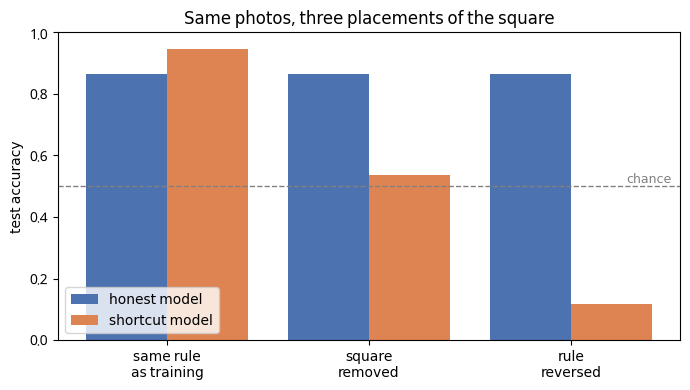
الاختبار        النزيه    الاختصار
مطابق            0.867       0.946
بلا مربّع        0.868       0.526
معكوس            0.867       0.086
حين تنعكس قاعدة المربّع، تهبط دقة نموذج الاختصار إلى 0.086. أما النموذج النزيه، على الصور نفسها، فيحقّق 0.867.
انتبه إلى أن الدقة نزلت تحت النصف. النموذج الذي يتجاهل الصورة ببساطة سيقف قرب التخمين العشوائي، أي قرب النصف. النزول تحت ذلك يعني أن النموذج ما زال يتبع قاعدة، لكنها صارت قاعدة خاطئة. معظم قراراته كانت تأتي من المربّع، فلما انعكس المربّع انعكس معظمها.
وحين نزيل المربّع كلياً، يحقّق نموذج الاختصار 0.526. هذه هي الحالة الواقعية: نموذج تدرّب على صور تحمل علامة مائية، ثم استُخدم على صور خالية منها. إنه ، ولم تكن أيّ بيانات اختبار عادية لتكشفه لك.
كلّ عمود قطةٌ طُبع عليها المربّع. قارن الصف السفلي بالصف الأوسط: أين تتركّز خريطة نموذج الاختصار؟
# Grad-CAM: weight each channel of the last 8x8 feature map by how much the
# predicted class's score depends on it, sum, and keep the positive part.
# The result is a coarse map of where the evidence for the decision came from.
#
# We probe BOTH models on the same images — every test photo with the square
# stamped on — and measure how much of each map lands on the square's cell.
CELL = 32 // 8  # one Grad-CAM cell covers 4x4 input pixels
# The square sits in the last cell, but an 8x8 map is coarse and its peak
# smears one cell inward, so we count the corner block that reaches one cell
# beyond the square. `uniform_share` below is that block's share of a flat map.
r0 = max(0, (32 - PATCH) // CELL - 1)
patch_cells = slice(r0, 8)


def gradcam(model, images_u8):
    """Return (cams[N, 8, 8], predicted labels) for a batch."""
    feats = model.features(to_input(images_u8))
    feats.retain_grad()
    logits = model.head(feats.mean(dim=(2, 3)))
    pred = logits.argmax(1)
    model.zero_grad(set_to_none=True)
    logits.gather(1, pred[:, None]).sum().backward()
    weights = feats.grad.mean(dim=(2, 3), keepdim=True)
    cams = F.relu((weights * feats).sum(1)).detach()
    return cams, pred.detach()


def patch_attention(model, images_u8):
    """Mean share of Grad-CAM mass that falls on the square's cell(s)."""
    shares = []
    for i in range(0, len(images_u8), 250):
        cams, _ = gradcam(model, images_u8[i : i + 250])
        mass = cams.sum(dim=(1, 2))
        on_patch = cams[:, patch_cells, patch_cells].sum(dim=(1, 2))
        valid = mass > 0
        shares.append((on_patch[valid] / mass[valid]).cpu())
    return float(torch.cat(shares).mean())


probe = paint(x_test, torch.ones(n_test, dtype=torch.bool, device=device))
patch_attention_honest = round(patch_attention(honest, probe), 4)
patch_attention_shortcut = round(patch_attention(shortcut, probe), 4)
attention_gap = round(patch_attention_shortcut - patch_attention_honest, 4)
uniform_share = round(((8 - r0) ** 2) / 64, 4)


# Pick demonstrative examples instead of indexing blindly: cats that the
# honest model calls cat, the shortcut model calls dog, once the square is on.
def gradcam_all(model, images_u8):
    parts = [gradcam(model, images_u8[i : i + 250]) for i in range(0, len(images_u8), 250)]
    return torch.cat([c for c, _ in parts]), torch.cat([p for _, p in parts])


cats = (y_test == 0).nonzero().squeeze(1)
cam_h, pred_h = gradcam_all(honest, probe[cats])
cam_s, pred_s = gradcam_all(shortcut, probe[cats])
fooled = ((pred_h == 0) & (pred_s == 1)).nonzero().squeeze(1)[:6]
if len(fooled) == 0:  # nothing qualified: show the first cats rather than nothing
    fooled = torch.arange(6, device=device)


def up(c):
    return F.interpolate(
        c[None, None],
        size=32,
        mode="bilinear",
        align_corners=False,
    )[0, 0].cpu()


fig, axes = plt.subplots(3, len(fooled), figsize=(1.9 * len(fooled), 6))
axes = np.array(axes).reshape(3, -1)
row_titles = [
    label("photo + square", "الصورة + المربّع"),
    label("honest model", "النموذج النزيه"),
    label("shortcut model", "نموذج الاختصار"),
]


def pred_name(p):
    return label("dog", "كلب") if p == 1 else label("cat", "قطة")


for j, k in enumerate(fooled.tolist()):
    img = probe[cats[k]].permute(1, 2, 0).cpu().numpy()
    axes[0, j].imshow(img, interpolation="nearest")
    for row, (cams, preds) in enumerate([(cam_h, pred_h), (cam_s, pred_s)], start=1):
        axes[row, j].imshow(img, interpolation="nearest")
        axes[row, j].imshow(up(cams[k]), cmap="jet", alpha=0.5)
        axes[row, j].set_xlabel(pred_name(preds[k].item()), fontsize=9)
for row in range(3):
    for ax in axes[row]:
        ax.set_xticks([])
        ax.set_yticks([])
    axes[row, 0].set_ylabel(row_titles[row], fontsize=9)
fig.suptitle(
    label("Cats with the square: where each model looked", "قطط تحمل المربّع: أين نظر كلّ نموذج")
)
plt.tight_layout()
plt.show()

if env.lang == "ar":
    print("حصّة خريطة Grad-CAM الواقعة على المربّع (على صور الاختبار كلّها):")
    print(f"  لو توزّعت الخريطة بالتساوي   {uniform_share:.3f}")
    print(f"  النموذج النزيه               {patch_attention_honest:.3f}")
    print(f"  نموذج الاختصار               {patch_attention_shortcut:.3f}")
else:
    print("share of the Grad-CAM map that lands on the square (whole test set):")
    print(f"  if spread evenly   {uniform_share:.3f}")
    print(f"  honest model       {patch_attention_honest:.3f}")
    print(f"  shortcut model     {patch_attention_shortcut:.3f}")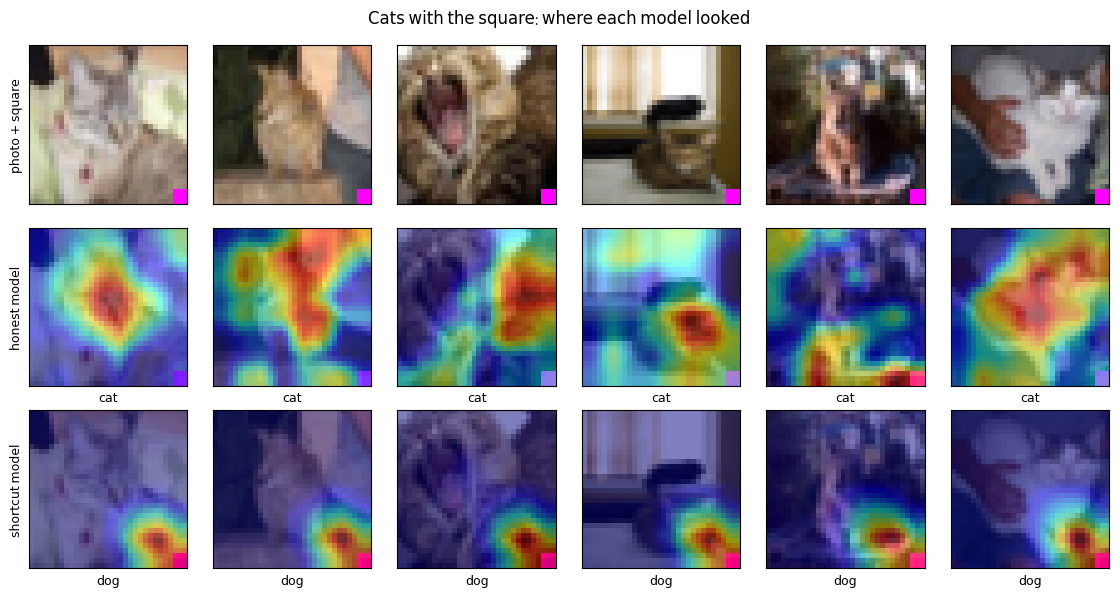
حصّة خريطة Grad-CAM الواقعة على المربّع (على صور الاختبار كلّها):
  لو توزّعت الخريطة بالتساوي   0.062
  النموذج النزيه               0.038
  نموذج الاختصار               0.411
طبعنا المربّع على كلّ صور الاختبار، ثم قسنا حصّة الزاوية المحيطة به من خريطة Grad-CAM. لدى نموذج الاختصار تبلغ هذه الحصّة 0.411، ولدى النموذج النزيه 0.038. ولو توزّعت الخريطة على الصورة بالتساوي، لكانت حصّة الزاوية 0.063.
جدول الدقة أخبرك أن هناك خللاً. أما الخرائط فتخبرك ما هو هذا الخلل. والأهم أنها كانت ستخبرك به حتى لو لم تبنِ اختبار القاعدة المعكوسة.
هذه هي القيمة العملية لـ. في المشاريع الحقيقية لن تملك غالباً اختباراً معكوساً جاهزاً، لأنك لا تعرف الاختصار مسبقاً. لكنك تستطيع دائماً أن تسأل النموذج أين نظر.
وتبقى ملاحظة واحدة للحذر. يقرأ Grad-CAM خريطة من 8 في 8، فيستطيع أن يحدّد الزاوية لكنه لا يحدّد المربّع بدقة. الخريطة الخشنة دليلٌ على المكان الذي ينبغي أن تفحصه بعد ذلك، وليست برهاناً على ما يحسبه النموذج.
تمرين
وافق المربّع التسمية بنسبة 0.95. والارتباطات الزائفة في البيانات الحقيقية كثيراً ما تكون أضعف من ذلك بكثير. خفّض قيمة my_rate وأعد تشغيل الخلية.
لكن قبل التشغيل، اكتب تخمينك: عند أيّ نسبة يختفي الفارق بين دقة الاختبار المطابق ودقة الاختبار المعكوس؟ وهل ينخفض انتباه النموذج إلى المربّع معه؟
# YOUR TURN.
#
# The planted square agreed with the label most of the time. How weak can a
# spurious correlation be and still get taken? Set `my_rate` and re-run this
# cell. 0.5 means the square carries no information; 1.0 means it is perfect.
#
# Predict first: at what rate does the flipped-test accuracy stop falling
# below the matched-test accuracy?
my_rate = 0.75

ex_flags = draw_flags(y_train, my_rate, torch.Generator().manual_seed(env.cfg["seed"]))
ex_model = train(ex_flags, env.cfg["seed"], env.cfg["epochs"], f"rate={my_rate}")
ex_gen = torch.Generator().manual_seed(env.cfg["seed"] + 1)
ex_matched = accuracy(ex_model, paint(x_test, draw_flags(y_test, my_rate, ex_gen)))
ex_flipped = accuracy(ex_model, paint(x_test, draw_flags(y_test, 1.0 - my_rate, ex_gen)))
ex_attention = patch_attention(ex_model, probe)

if env.lang == "ar":
    print(
        f"\nنسبة الارتباط {my_rate}:  مطابق {ex_matched:.3f}   معكوس {ex_flipped:.3f}"
        f"   الانهيار {ex_matched - ex_flipped:+.3f}   انتباه المربّع {ex_attention:.3f}"
    )
else:
    print(
        f"\nrate {my_rate}:  matched {ex_matched:.3f}   flipped {ex_flipped:.3f}"
        f"   collapse {ex_matched - ex_flipped:+.3f}   attention on square {ex_attention:.3f}"
)يتوفّر تلميح في الدفتر — env.hint(2)
كان العثور على المربّع سهلاً لأنك أنت من زرعه. الاختصارات الحقيقية لا تعلن عن نفسها. لكن ما تعلّمته هنا ينتقل معك في صورة أسئلة تطرحها على أيّ نتيجة تبدو جيدة.
هل جُمعت مجموعة الاختبار بالطريقة نفسها التي جُمعت بها مجموعة التدريب؟ إن كان الجواب نعم، فهي تحمل مصادفات مجموعة التدريب نفسها.
كم ستكون الدقة لو أزلنا خاصية مشبوهة واحدة، أو عكسناها؟ ابنِ هذا الاختبار حتى لو كان بناؤه مزعجاً.
أين ينظر النموذج؟ رسم خريطة إسناد يستغرق ثوانيَ. وهو الفحص الوحيد بين هذه الثلاثة الذي لا يتطلّب أن تعرف الاختصار مسبقاً.
نفحص مرجع المقارنة أولاً. أما ذروة ذاكرة GPU المطبوعة في النهاية، فهي الرقم الذي ينبغي أن يُعلنه الملف الشخصي.
# The control comes first: a shortcut can only be "caught" relative to a model
# that actually learned cats and dogs. If this fails, train longer.
honest_ok = env.check("honest-model-learns", honest_clean_acc)
collapse_ok = env.check("shortcut-collapses", shortcut_collapse)
attention_ok = env.check("gradcam-finds-square", attention_gap)

if device == "cuda":  # the measured peak is what `requires.vramGb` should declare
    peak_vram_gb = round(torch.cuda.max_memory_allocated() / 1e9, 2)
    if env.lang == "ar":
        print(f"ذروة استهلاك ذاكرة GPU: {peak_vram_gb} GB")
    else:
print(f"peak VRAM: {peak_vram_gb} GB")✓ دقة النموذج النزيه على صور اختبار نظيفة: 0.8675 (المطلوب ≥ 0.75)
✓ ما يخسره نموذج الاختصار من دقّته حين تنعكس قاعدة المربّع: 0.8605 (المطلوب ≥ 0.3)
✓ الحصّة الزائدة من خريطة <bdi dir="ltr">Grad-CAM</bdi> على المربّع لدى نموذج الاختصار مقارنةً بالنموذج النزيه: 0.3732 (المطلوب ≥ 0.1)
ذروة استهلاك ذاكرة GPU: 0.95 GBreceipt = env.receipt()اكتملت الورشة.
رمز الإتمام: AZ-██████████
الصقه في صفحة الورشة على أزيموث لتسجيل إتمامها.مصطلحات هذه الورشة
- التعميمGeneralization
- فرط التخصيصOverfitting
- التصنيفClassification
- خريطة حراريةHeatmap
- خارج التوزيعOut-of-Distribution
- المتانةRobustness