الأنظمة والتوسّعintermediateمعالج رسوميات~40 دقيقةColab
التكميم: الثمن الحقيقي لـ int8 و int4
Quantization: what int8 and int4 actually cost
ثلاث تكاليف، والتي لم تحسب حسابها تسير في الاتجاه المعاكس
أسهل طريقة لتقليل حجم النموذج عند : تخزّن الأوزان ببتّات أقل، فيعمل النموذج على بطاقات لم تكن تتّسع له من قبل. الأوراق البحثية تؤكّد أن الطريقة تنجح. لكنها لا تستطيع أن تخبرك بما سيخسره نموذجك أنت تحديداً، لأن الإجابة تعتمد على النموذج نفسه، وعلى البيانات، وعلى أيّ أجزاء الشبكة احتفظت بدقتها العددية وأيّها ضُغط أكثر.
السؤال المهم إذن ليس «هل تعمل int4؟»، بل: أيّ التكاليف الثلاث يتحرك فعلاً؟ الذاكرة تنخفض كما تتوقع. الجودة بالكاد تتأثر، وهذا ما أثبتته الأبحاث. أما فيفعل شيئاً لا يهيّئك له أيّ ملخّص بحثي: قد يسوء بدل أن يتحسّن. والأغرب أن هذا السوء لا يتدرّج مع عدد البتّات، فالصيغة الأقل بتّات ليست بالضرورة الأبطأ. وحين تقيس التكاليف الثلاث معاً، لن يعود قرار النشر واضحاً كما بدا.
الهدف
قِس الحيرة والذاكرة وزمن الاستجابة للنموذج نفسه بثلاث صيغ: <Term en="FP16">fp16</Term> وint8 وint4، ثم ارسم المقاييس الثلاثة جنباً إلى جنب، وحدّد أيّها يتحرك أولاً وأيّها يكاد لا يتغيّر.
يفتح Colab نسخة للقراءة فقط. احفظ نسخة في Drive للاحتفاظ بتعديلاتك.
يحتاج الدفتر إلى لوحة مفاتيح — يُفضَّل فتحه على حاسوب مكتبي.
الأوراق وراء هذه الورشة
حين تُكمِّم نموذجاً، تتحرك ثلاثة أرقام، لكنها لا تتحرك معاً. الذاكرة تنخفض تقريباً بقدر ما ينخفض عدد البتّات، وهذا الجزء مجرد حساب. والجودة تتراجع هي أيضاً، لكن ليس بسلاسة: تبقى شبه ثابتة لفترة، ثم ترتفع فجأة. أما زمن الاستجابة فهو المفاجأة، لأنه قد يسير في الاتجاه المعاكس تماماً.
لهذا نقيس الثلاثة معاً في هذه الورشة. الورقة البحثية التي تعرض الحيرة وحدها لا تُخفي عنك شيئاً. هي ببساطة تجيب عن سؤال غير سؤالك، حين تقرّر ما الذي ستنشره فعلاً.
تهيئة أولية. هذه أول ورشة هنا تحتاج فعلاً إلى معالج رسوميات: نوى الحساب الخاصة بـ int8 وint4 لا تعمل إلا على CUDA.
import azimuth_nb as azimuth

env = azimuth.setup(SLUG, lang=LANG, profile=PROFILE)التكميم: ما تكلّفه الدقة الثمانية والرباعية فعلاً
Tesla T4 · 14.6 غ.ب · ذاكرة 12.7 غ.ب · PyTorch 2.11.0+cu128
الملف: free
جاهز · model=facebook/opt-350m, evalTokens=40000, latencyRuns=20, newTokens=64, seed=17
الشيفرة · 6de6a8c98dc1a822ابنِ نوافذ التقييم مرة واحدة، قبل تحميل أيّ نموذج. كل الصيغ تُقيَّم على النص نفسه حرفياً، لأن سحب عيّنة مختلفة لكل نموذج قد يدفن تراجعاً حقيقياً تحت ضجيج العيّنات.
import torch
from datasets import load_dataset
from transformers import AutoTokenizer

MODEL = env.cfg["model"]
tokenizer = AutoTokenizer.from_pretrained(MODEL)

# BUILD THE WINDOWS ONCE, BEFORE ANY MODEL LOADS.
#
# Every variant is scored on byte-identical text. Re-sampling per model would
# put sampling noise on the same axis as the effect being measured, and a real
# int4 regression could hide inside it — the numbers would still look precise.
# `Salesforce/wikitext`, not bare `wikitext`: the Hub now requires the owning
# org for this dataset, and the bare name resolves to nothing. Exactly the
# volatile-tier rot this workshop exists to demonstrate the pinning for .
raw = load_dataset("Salesforce/wikitext", "wikitext-2-raw-v1", split="test")
text = "\n\n".join(t for t in raw["text"] if t.strip())
all_ids = tokenizer(text, return_tensors="pt").input_ids[0][: env.cfg["evalTokens"]]

WINDOW = 512
windows = [all_ids[i : i + WINDOW] for i in range(0, len(all_ids) - WINDOW, WINDOW)]
n_windows = len(windows)

if env.lang == "ar":
    print(f"النموذج: {MODEL}")
    print(f"نوافذ التقييم: {n_windows} نافذة × {WINDOW} رمز")
else:
    print(f"model: {MODEL}")
print(f"eval windows: {n_windows} × {WINDOW} tokens")النموذج: facebook/opt-350m
نوافذ التقييم: 78 نافذة × 512 رمزنحمّل النموذج ثلاث مرات، ونأخذ ثلاثة قياسات في كل مرة. ونحرّر الذاكرة بين الصيغ حتى يعكس رقم الذاكرة النموذج نفسه، لا بقايا التحميل السابق.
import gc
import time

from transformers import AutoModelForCausalLM, BitsAndBytesConfig


def load(variant):
    """One model, three ways. Only the dtype/quantization config differs."""
    if variant == "fp16":
        # `dtype`, not `torch_dtype` — renamed in transformers 5. The old name
        # still works and warns, which is exactly how a workshop keeps running
        # for a year and then stops.
        kwargs = {"dtype": torch.float16}
    elif variant == "int8":
        kwargs = {"quantization_config": BitsAndBytesConfig(load_in_8bit=True)}
    else:
        kwargs = {
            "quantization_config": BitsAndBytesConfig(
                load_in_4bit=True,
                # NF4 rather than plain int4: GPTQ's lesson is that WHERE the
                # levels sit matters as much as how many there are.
                bnb_4bit_quant_type="nf4",
                bnb_4bit_compute_dtype=torch.float16,
            )
        }
    return AutoModelForCausalLM.from_pretrained(MODEL, device_map="cuda:0", **kwargs)


def perplexity(model):
    """Mean NLL over the shared windows, exponentiated."""
    model.eval()
    total, count = 0.0, 0
    with torch.no_grad():
        for window in windows:
            ids = window.unsqueeze(0).to("cuda:0")
            loss = model(ids, labels=ids).loss
            total += loss.item() * ids.numel()
            count += ids.numel()
    return float(torch.exp(torch.tensor(total / count)))


def footprint(model):
    """Megabytes of parameters as actually stored, not as declared.

    Reading nelement * element_size per parameter is the honest measure: a
    4-bit tensor reports element_size 1 with two values packed per byte, so
    counting declared dtypes would overstate int4 by exactly the factor the
    workshop is trying to measure.
    """
    return sum(p.nelement() * p.element_size() for p in model.parameters()) / 1024**2


def latency(model, runs, new_tokens):
    """Median milliseconds per generated token, single sequence."""
    prompt = windows[0][:64].unsqueeze(0).to("cuda:0")
    with torch.no_grad():  # warm the kernels before timing anything
        model.generate(prompt, max_new_tokens=8, do_sample=False)
    torch.cuda.synchronize()
    times = []
    for _ in range(runs):
        start = time.perf_counter()
        with torch.no_grad():
            model.generate(prompt, max_new_tokens=new_tokens, do_sample=False)
        torch.cuda.synchronize()
        times.append((time.perf_counter() - start) * 1000 / new_tokens)
    times.sort()
    return times[len(times) // 2]


results = {}
peak_gb = 0.0
for variant in ("fp16", "int8", "int4"):
    # Reset before each variant so the peak is THIS model's, not a high-water
    # mark left by the previous one.
    torch.cuda.reset_peak_memory_stats()
    model = load(variant)
    results[variant] = {
        "ppl": perplexity(model),
        "mb": footprint(model),
        "ms": latency(model, env.cfg["latencyRuns"], env.cfg["newTokens"]),
    }
    # PEAK allocated, not the weight footprint. The weights are under a
    # gigabyte; what actually decides whether this fits on a card is the
    # activations and the KV cache during generate. Reporting it turns the
    # profile's `vramGb` from a guess into a measurement — the first version
    # declared 14 GB because that is what a T4 has, which locked out every
    # 8 GB card for no reason.
    variant_peak = torch.cuda.max_memory_allocated() / 1024**3
    peak_gb = max(peak_gb, variant_peak)
    print(
        f"  {variant:5} ppl {results[variant]['ppl']:7.3f}"
        f"  {results[variant]['mb']:8.1f} MB"
        f"  {results[variant]['ms']:6.1f} ms/token"
        f"  peak {variant_peak:4.1f} GB"
    )
    # Freed between variants so the memory figure is the model, not leftovers.
    del model
    gc.collect()
    torch.cuda.empty_cache()

if env.lang == "ar":
    print(f"\nذروة ذاكرة المعالج: {peak_gb:.1f} غ.ب — هذا ما ينبغي أن يعلنه vramGb")
else:
    print(f"\npeak VRAM: {peak_gb:.1f} GB — this is what `vramGb` should declare")

fp16_ppl, int8_ppl, int4_ppl = (results[v]["ppl"] for v in ("fp16", "int8", "int4"))
fp16_mb, int8_mb, int4_mb = (results[v]["mb"] for v in ("fp16", "int8", "int4")) fp16 ppl 34.655 631.7 MB 14.6 ms/token peak 0.9 GB
int8 ppl 34.705 342.7 MB 58.9 ms/token peak 0.6 GB
/usr/local/lib/python3.13/dist-packages/bitsandbytes/backends/cuda/ops.py:447: FutureWarning: _check_is_size will be removed in a future PyTorch release along with guard_size_oblivious. Use _check(i >= 0) instead.
torch._check_is_size(blocksize)
int4 ppl 37.839 198.2 MB 25.8 ms/token peak 0.5 GB
ذروة ذاكرة المعالج: 0.9 غ.ب — هذا ما ينبغي أن يعلنه vramGbالتكاليف الثلاث في رسم واحد، وكل المحاور تبدأ من الصفر حتى لا يبدو خط مستوٍ منحدراً. اثنتان منها تتصرّفان كما تتوقع. والثالثة هي سبب وجود هذه الورشة.
import matplotlib.pyplot as plt

memory_ratio = fp16_mb / int4_mb
ppl_ratio_int8 = int8_ppl / fp16_ppl
ppl_ratio_int4 = int4_ppl / fp16_ppl

variants = ["fp16", "int8", "int4"]
fig, axes = plt.subplots(1, 3, figsize=(9, 2.8))
for ax, key, title in zip(
    axes,
    ["ppl", "mb", "ms"],
    ["perplexity", "memory (MB)", "ms / token"],
):
    values = [results[v][key] for v in variants]
    ax.plot(variants, values, marker="o", color="#457b9d")
    ax.set_title(title, fontsize=10)
    ax.spines[["top", "right"]].set_visible(False)
    # Zero-based so a flat line LOOKS flat. Autoscaled axes turn a 1% change
    # into a dramatic slope, which is how a chart lies without a wrong number
    # anywhere in it.
    ax.set_ylim(0, max(values) * 1.2)
fig.tight_layout()
plt.show()

if env.lang == "ar":
    print(f"الذاكرة: النصفية أكبر بـ {memory_ratio:.2f}× من الرباعية")
    print(f"الحيرة: ثمانية {ppl_ratio_int8:.3f}× · رباعية {ppl_ratio_int4:.3f}×")
else:
    print(f"memory: fp16 is {memory_ratio:.2f}× larger than int4")
    print(f"perplexity: int8 {ppl_ratio_int8:.3f}× · int4 {ppl_ratio_int4:.3f}×")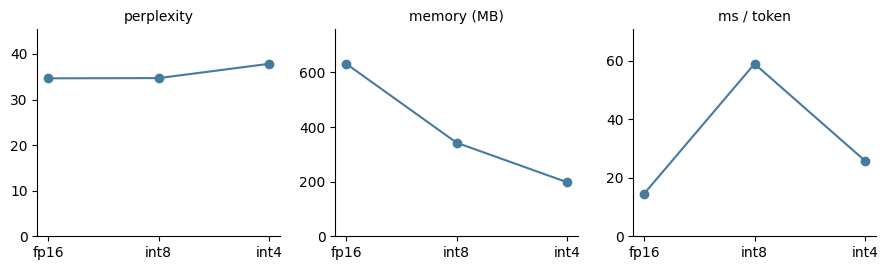
الذاكرة: النصفية أكبر بـ 3.19× من الرباعية
الحيرة: ثمانية 1.001× · رباعية 1.092×
هذا هو الرقم الذي يسير عكس التوقع. انتبه إلى الترتيب، لا إلى الاتجاه وحده: إذا كانت صيغة ببتّات أكثر أسرع من صيغة ببتّات أقل، فالتكلفة ليست في عدد البتّات، بل في العمل الذي تؤدّيه النواة الحسابية حولها.
fp16_ms, int8_ms, int4_ms = (results[v]["ms"] for v in ("fp16", "int8", "int4"))

# Report the direction AND the order. The measured surprise is not just that
# quantized is slower — it is that int8 is slower than int4, i.e. the cost
# does not follow the bit count at all.
#
# int8 here runs LLM.int8()'s mixed-precision decomposition: outlier columns
# are split out and computed in fp16, then recombined. That is what buys the
# near-perfect quality two cells up, and it is not free. NF4 does a plainer
# dequantize-and-matmul and lands between the two.
slowest = max(("fp16", fp16_ms), ("int8", int8_ms), ("int4", int4_ms), key=lambda x: x[1])
if env.lang == "ar":
    print(
        f"زمن الاستجابة: نصفية {fp16_ms:.1f} · ثمانية {int8_ms:.1f} · رباعية {int4_ms:.1f} م.ث/رمز"
    )
    verdict = "أبطأ" if int4_ms > fp16_ms else "أسرع"
    print(
        f"الرباعية {verdict} من النصفية بعامل {max(int4_ms, fp16_ms) / min(int4_ms, fp16_ms):.2f}"
    )
else:
    print(f"latency: fp16 {fp16_ms:.1f} · int8 {int8_ms:.1f} · int4 {int4_ms:.1f} ms/token")
    verdict = "SLOWER" if int4_ms > fp16_ms else "faster"
    print(f"int4 is {verdict} than fp16 by {max(int4_ms, fp16_ms) / min(int4_ms, fp16_ms):.2f}×")
    if slowest[0] != "int4":
        print(
            f"and the slowest is not the smallest — it is {slowest[0]}. The cost is not the bits."
)زمن الاستجابة: نصفية 14.6 · ثمانية 58.9 · رباعية 25.8 م.ث/رمز
الرباعية أبطأ من النصفية بعامل 1.77تمرين
اختر صيغة لسيناريو نشر محدّد، وبرّر اختيارك بالأرقام التي قِستها أنت لا بالقيم الافتراضية. حدّد القيد أولاً — مثلاً «يجب أن يعمل ضمن 8 غيغابايت» أو «أقل من 50 مللي ثانية للرمز الواحد» أو «جودة في حدود 2٪ من fp16» — ثم اقرأ الجدول واختر.
ثم انتبه لما فرضه عليك التمرين. حين يكون أمامك رقم واحد، تكتفي بتحسينه. وحين تكون أمامك ثلاثة أرقام، تُضطر إلى تحديد قيد. وهذا القيد قرار يخصّ المنتج، لا قرار تقني. أيّ التكاليف الثلاث لن تتنازل عنها أبداً؟ وهل تتغيّر إجابتك لو كان التطبيق روبوت محادثة بدلاً من أداة تلخّص المستندات على دفعات؟
# YOUR TURN.
#
# State the constraint BEFORE reading the table. Then let the table choose.
# Chosen to sit AWAY from the measured values, not on top of them. A 60 ms
# ceiling put int8 at 58.5 on one run and 62.8 on another, so the two language
# builds of this page disagreed about which variant was viable — from timing
# noise, on identical code. A default that flips on noise teaches that the
# method is unreliable rather than that the choice is yours.
BUDGET_MB = 400
MAX_MS_PER_TOKEN = 80
MAX_PPL_RATIO = 1.05

viable = [
    v
    for v in variants
    if results[v]["mb"] <= BUDGET_MB
    and results[v]["ms"] <= MAX_MS_PER_TOKEN
    and results[v]["ppl"] / fp16_ppl <= MAX_PPL_RATIO
]
print(f"viable under your constraints: {viable or 'none — loosen one, and say which'}")يتوفّر تلميح في الدفتر — env.hint(2)
الذاكرة يجب أن تنخفض فعلاً، وint8 يجب أن تصمد جودتها. إذا تحرّكت حيرة int8 بشكل ملحوظ، ارجع إلى التلميح الثالث.
memory_ok = env.check("memory-falls", memory_ratio)
quality_ok = env.check("quality-survives-int8", ppl_ratio_int8)✓ الذاكرة الموفَّرة بالدقة الرباعية منسوبةً إلى النصفية: 3.187 (المطلوب ≥ 1.5)
✓ حيرة الدقة الثمانية منسوبةً إلى النصفية: 1.001 (المطلوب ≥ 0.85 و≤ 1.15)receipt = env.receipt()اكتملت الورشة.
رمز الإتمام: AZ-██████████
الصقه في صفحة الورشة على أزيموث لتسجيل إتمامها.مصطلحات هذه الورشة
- التكميمQuantization
- معيار الحيرة الاحتماليةPerplexity
- فك التكميمDequantization