الشبكات العصبيةintermediateمعالج رسوميات~15 دقيقةColab
أوتوماتا خلوية عصبية تنمو: الهدف محطة عبور لا نقطة استقرار
Growing neural cellular automata: the target is a waypoint, not a fixed point
الثبات تشتريه بالحالات التي تدرّب منها، لا بما تطلبه دالة الخسارة
خلية واحدة في مركز شبكة فارغة. وعلى الشبكة كلها تعمل قاعدة صغيرة، لا تتجاوز بضعة آلاف من المعاملات، وتشترك فيها الخلايا جميعاً. ولا ترى كل خلية سوى قنواتها وجوارها المباشر: مربّعاً بمقاس ثلاثة في ثلاثة، لا أكثر. تُطبَّق هذه القاعدة على الشبكة مرّةً بعد مرّة. لا أحد يخبر النظام أين تنتهي حواف الشكل، ولا شيء يعدّ الخطوات، ولا توجد خطة في أي مكان. وبعد بضع عشرات من التطبيقات تظهر زهرة.
هذا القدر هو نتيجة الورقة البحثية، وقراءتها تكفي لمعرفته. لكن القراءة لا تخبرك بما يحدث عند الخطوة المئة. لو درّبت القاعدة بالطريقة البديهية — تبدأ من البذرة، وتشغّلها بضع عشرات من الخطوات، ثم تطلب أن يشبه الناتج الهدف — لحصلت على قاعدة تبلغ الزهرة ثم تواصل التغيّر وتتجاوزها. والسبب أن التدريب لم يطلب منها في أي لحظة أن تبقى. كانت الزهرة محطةً مرّ بها الحالة، لا يستقرّ عنده.
تدرّب هذه الورشة قاعدتين لا تختلفان إلا في أمر واحد: الحالات التي تبدأ منها كل دفعة تدريب. البنية واحدة، والأوزان الابتدائية واحدة، والمحسِّن واحد، والميزانية واحدة، ودالة الخسارة واحدة حرفاً بحرف. تبدأ إحداهما كل دفعة من البذرة، وتبدأ الأخرى من حالات أنتجتها هي نفسها في خطوات سابقة، وفي بعض هذه الحالات ثقبٌ مقصود. وعند نهاية المدى الذي دُرِّبتا عليه تكون قاعدة البذرة هي الأفضل: خسارتها أدنى، ومطابقتها للزهرة أقرب. لكن عند أربعة أضعاف ذلك المدى ينحدر تطابقها إلى 0.365، بينما تحافظ الأخرى على 0.961. وإذا قطعتَ كلاً منهما نصفين، فواحدة فقط تعود.
الهدف
درّب القاعدتين، وشاهد الزهرة تنمو من خلية واحدة، ثم قِس ثلاثة أشياء لم تطلبها دالة الخسارة قط: مدى مطابقة كل قاعدة للهدف بعد تجاوز المدى الذي دُرِّبت عليه بكثير، والفارق بينهما هناك، وكم تستعيد الزهرة المكتملة من شكلها بعد محو نصف الشبكة.
يفتح Colab نسخة للقراءة فقط. احفظ نسخة في Drive للاحتفاظ بتعديلاتك.
يحتاج الدفتر إلى لوحة مفاتيح — يُفضَّل فتحه على حاسوب مكتبي.
الأوراق وراء هذه الورشة
النموذج صغير بما يكفي لتستوعبه كاملاً في ذهنك. تحمل كل خلية حفنة أرقام: أربعة منها تُرسم على الشاشة لوناً وشفافية، وبقيتها لا تعني شيئاً بعينه، فالقاعدة هي التي تقرّر ما تحتفظ به هناك. وفي كل خطوة تنظر الخلية إلى نفسها وإلى جيرانها الثمانية عبر ثلاثة مرشّحات ثابتة، ثم تمرّر الناتج عبر وتضيفه إلى حالتها. هذا هو النموذج كله: واحدة، تعمل بالأوزان نفسها على كل خلية.
أمران فيه يستحقّان التوقّف، فكلاهما أساسي ولا يبدو أيٌّ منهما بديهياً. الأول أن أوزان طبقة المخرَج تبدأ أصفاراً. معنى ذلك أن القاعدة قبل التدريب لا تغيّر شيئاً، فكل خلية تبقى كما هي. وهكذا يتعلّم النموذج النمو انطلاقاً من حالة هادئة، بدل أن يقضي بداية التدريب في احتواء انفجار عددي.
والثاني أن : كل خلية تُحدَّث أو لا تُحدَّث عشوائياً، بمعزل عن غيرها، لا دفعةً واحدة. فلو تحرّكت الشبكة كلها معاً في كل خطوة، لكان ذلك ساعةً مركزية تضبط الإيقاع للجميع. وهذه الساعة بالذات هي التنسيق الذي يُفترض بالنموذج أن يستغني عنه.
تهيئة مبدئية. لا نطلب مسرّعاً — بضعة آلاف من المعاملات على بضع مئات من الخلايا لا تحتاج إليه، وطلبه سيكون مسرحية.
import arabic_reshaper
import azimuth_nb as azimuth
from bidi.algorithm import get_display

env = azimuth.setup(SLUG, lang=LANG, profile=PROFILE)أوتوماتا خلوية عصبية تنمو: الهدف محطة عبور لا نقطة استقرار
Tesla T4 · 14.6 غ.ب · ذاكرة 12.7 غ.ب · PyTorch 2.11.0+cu128
الملف: free
جاهز · grid=28, channels=12, hidden=96, batch=5, poolSize=128, minSteps=32, maxSteps=44, trainSteps=3000, learningRate=0.002, fireRate=0.5, aliveThreshold=0.1, damageRadius=0.18, damagePerBatch=2, growSteps=96, persistSteps=200, healSteps=96, logEvery=250, stripFrames=8, seed=17
الشيفرة · f154e4b6516f0a2bنرسم الشكل بالكود بدل تنزيله، فلا يوجد هنا رابط قد يتعطّل مع الوقت. ولاحظ أنه غير متماثل: الورقة الخضراء على جانب واحد من الساق فقط. لو كان الهدف متماثلاً، لاستطاعت تشغيلة المحو في النهاية أن تنجح بنسخ الجهة المقابلة بدل إعادة البناء، ولما ظهر أي فرق في الرقم. واحتفظ بخطأ الشبكة الفارغة المطبوع أدناه، فعليه تُقاس كل درجة في هذه الورشة.
import matplotlib.pyplot as plt
import numpy as np
import torch

GRID = env.cfg["grid"]

# The target is DRAWN, not downloaded. That keeps the maintenance tier stable:
# there is no URL to rot, no licence to track, and no asset to pin. It also
# means the shape can be resized with the profile instead of being resampled.


def make_target(grid: int) -> np.ndarray:
    """An asymmetric flower, as premultiplied RGBA in (4, grid, grid).

    Asymmetric ON PURPOSE. A radially symmetric target can be rebuilt from any
    surviving wedge, so a damage run against one would look like regeneration
    while only testing symmetry. Here the leaf sits left of the stem and
    nowhere else, so erasing the left half removes information that has to be
    reconstructed rather than copied from across an axis.
    """
    rgba = np.zeros((4, grid, grid), dtype=np.float32)
    yy, xx = np.mgrid[0:grid, 0:grid].astype(np.float32)
    cx, cy = (grid - 1) / 2.0, grid * 0.36

    def disc(px, py, r):
        return ((xx - px) ** 2 + (yy - py) ** 2) <= r * r

    petal_r, ring_r = grid * 0.145, grid * 0.20
    petals = np.zeros((grid, grid), dtype=bool)
    for k in range(6):
        angle = 2 * np.pi * k / 6
        petals |= disc(cx + ring_r * np.cos(angle), cy + ring_r * np.sin(angle), petal_r)
    centre = disc(cx, cy, grid * 0.115)

    stem = (np.abs(xx - cx) <= grid * 0.035) & (yy >= cy + grid * 0.10) & (yy <= grid * 0.86)
    lx, ly = cx - grid * 0.17, grid * 0.68
    leaf = (((xx - lx) / (grid * 0.14)) ** 2 + ((yy - ly) / (grid * 0.062)) ** 2) <= 1.0

    # Painted back to front, so the stem never cuts through the yellow centre.
    for mask, colour in (
        (stem, (0.20, 0.56, 0.28)),
        (leaf, (0.24, 0.66, 0.32)),
        (petals & ~centre, (0.86, 0.24, 0.36)),
        (centre, (0.98, 0.78, 0.18)),
    ):
        for channel in range(3):
            rgba[channel][mask] = colour[channel]
        rgba[3][mask] = 1.0

    rgba[:3] *= rgba[3]  # premultiplied: RGB is only meaningful where alpha is
    return rgba


device = torch.device("cuda" if torch.cuda.is_available() else "cpu")
target = torch.from_numpy(make_target(GRID)).to(device)

# THE DENOMINATOR OF EVERY SCORE BELOW, and the reason the scores mean
# anything. An empty grid is not a neutral prediction: the target is mostly
# transparent background, so a rule that dies immediately scores well on plain
# pixel error. Dividing by the error an EMPTY grid makes pins the empty run at
# exactly zero and a perfect run at one.
empty_error = float((target**2).mean())


def match(state: torch.Tensor) -> float:
    """How much of the target a state accounts for. Empty grid 0, perfect 1.

    Deliberately not clipped below zero. A rule that has overshot into noise is
    WORSE than one that never grew, and flattening that to zero would hide the
    failure this workshop is built to show.
    """
    error = float(((state[:, :4] - target) ** 2).mean())
    return 1.0 - error / empty_error


def to_rgb(state: torch.Tensor) -> np.ndarray:
    """Composite premultiplied RGBA over white, for display."""
    rgba = state[0, :4].detach().cpu().numpy() if state.dim() == 4 else state[:4].cpu().numpy()
    rgb, alpha = rgba[:3], np.clip(rgba[3], 0, 1)
    return np.clip(1.0 - alpha + rgb, 0, 1).transpose(1, 2, 0)


alive_fraction = float((target[3] > 0.1).float().mean())

fig, axis = plt.subplots(figsize=(2.6, 2.6))
axis.imshow(to_rgb(target), interpolation="nearest")
axis.axis("off")
fig.tight_layout()
plt.show()

env.explain("morphogenesis")
if env.lang == "ar":
    print(f"الهدف {GRID}×{GRID} · {alive_fraction:.2f} من الخلايا حيّة")
    print(f"خطأ الشبكة الفارغة {empty_error:.4f} · عليه تُقسم كل درجات التطابق التالية")
else:
    print(f"target {GRID}x{GRID} · {alive_fraction:.2f} of cells alive")
    print(f"empty-grid error {empty_error:.4f} — the denominator of every match score below")
morphogenesis — تشكُّل بناءٍ من تفاعلات محلية لا من مخطّط مرسوم سلفاً. والسؤال ليس ما هو الشكل، بل ما القاعدة التي تجعله يظهر.
الهدف 28×28 · 0.36 من الخلايا حيّة
خطأ الشبكة الفارغة 0.1788 · عليه تُقسم كل درجات التطابق التاليةقارن عدد المعاملات بعدد خلايا الشبكة. لا تكفي هذه المعاملات لتخزين صورة، والقاعدة على أي حال لا ترى إحداثياً واحداً. إذن فما يخبر الخلية بأنها بتلة لا ساق يُحسب محلياً في كل خطوة انطلاقاً من جيرانها، وهذا هو معنى أن يكون على الشبكة بدل أن يكون مخزّناً في مكان بعينه.
import torch.nn as nn
import torch.nn.functional as F

CHANNELS = env.cfg["channels"]
ALIVE = env.cfg["aliveThreshold"]

# Channels 0-3 are RGBA and are the only ones the loss ever sees. The rest are
# unconstrained scratch space: nothing tells the rule what to put there, and
# whatever it stores is the closest thing this system has to a signal passed
# between neighbours.
HIDDEN_CHANNELS = CHANNELS - 4

_IDENTITY = torch.tensor([[0.0, 0.0, 0.0], [0.0, 1.0, 0.0], [0.0, 0.0, 0.0]])
_SOBEL_X = torch.tensor([[-1.0, 0.0, 1.0], [-2.0, 0.0, 2.0], [-1.0, 0.0, 1.0]]) / 8.0
_PERCEPTION = torch.stack([_IDENTITY, _SOBEL_X, _SOBEL_X.t()])


class CellRule(nn.Module):
    """The whole model. One rule, shared by every cell on the grid.

    There is no global state, no coordinate input and no step counter. A cell
    sees its own channels and a 3x3 neighbourhood, and that is all. Everything
    the grid does over time has to be produced by this one function applied
    everywhere at once.
    """

    def __init__(self, channels: int, hidden: int):
        super().__init__()
        # Fixed, not learned: identity plus two Sobel gradients per channel.
        # Registered as a buffer so it moves with .to(device) but never
        # receives a gradient.
        self.register_buffer("filters", _PERCEPTION.repeat(channels, 1, 1).unsqueeze(1))
        self.channels = channels
        self.dense1 = nn.Conv2d(channels * 3, hidden, 1)
        self.dense2 = nn.Conv2d(hidden, channels, 1, bias=False)
        # ZERO INIT on the output layer, so the rule starts as the identity
        # map: every cell initially does nothing. Growth then has to be learned
        # rather than unlearned from random noise, and the first few hundred
        # steps are not spent recovering from an explosion.
        nn.init.zeros_(self.dense2.weight)

    def alive(self, x: torch.Tensor) -> torch.Tensor:
        """A cell is alive if it or a neighbour has meaningful alpha."""
        return F.max_pool2d(x[:, 3:4], 3, stride=1, padding=1) > ALIVE

    def forward(self, x: torch.Tensor, fire_rate: float) -> torch.Tensor:
        pre_alive = self.alive(x)
        perception = F.conv2d(x, self.filters, padding=1, groups=self.channels)
        dx = self.dense2(F.relu(self.dense1(perception)))
        # Stochastic update: each cell acts independently with probability
        # fire_rate. Without it the grid updates in lockstep, which is a global
        # clock — exactly the kind of coordination this model is supposed to do
        # without.
        fire = (torch.rand_like(x[:, :1]) <= fire_rate).float()
        x = x + dx * fire
        return x * (pre_alive & self.alive(x)).float()


def make_seed(n: int) -> torch.Tensor:
    """n grids, empty except for one cell at the centre with every channel set."""
    seed = torch.zeros(n, CHANNELS, GRID, GRID, device=device)
    seed[:, 3:, GRID // 2, GRID // 2] = 1.0
    return seed


torch.manual_seed(env.cfg["seed"])
reference = CellRule(CHANNELS, env.cfg["hidden"]).to(device)
param_count = sum(w.numel() for w in reference.parameters())

env.explain("update rule")
if env.lang == "ar":
    # Arabic number agreement changes between 3-10 and 11+, and both profiles
    # are in play here, so the counts are phrased to sidestep it entirely
    # rather than being correct on the free tier and wrong on the paper one.
    print(f"{param_count:,} معامل · قاعدة واحدة تشترك فيها كل خلية")
    print(f"لكل خلية {CHANNELS} قناة: أربع منها RGBA، وبقيتها حرّة")
else:
    print(f"{param_count:,} parameters — one rule, shared by every cell")
print(f"{CHANNELS} channels per cell: 4 are RGBA, {HIDDEN_CHANNELS} are unconstrained")update rule — الدالة المطبَّقة على كل خلية في كل خطوة، وهي هنا شبكة التفافية صغيرة، وهي وحدها ما يُتعلَّم. فكل ما تفعله الشبكة عبر الزمن تكرارٌ لهذه الدالة وحدها.
4,704 معامل · قاعدة واحدة تشترك فيها كل خلية
لكل خلية 12 قناة: أربع منها RGBA، وبقيتها حرّةهذه أطول خلية كود في الورشة، والوحيدة التي تدرّب شيئاً. تتدرّب فيها القاعدتان واحدةً بعد الأخرى، وفي كلتيهما يعود إلى الوراء خلال عشرات التطبيقات المتتالية للقاعدة نفسها. راقب الخسارتين النهائيتين: خسارة قاعدة البذرة أدنى بفارق واسع، ومطابقتها للزهرة أقرب كذلك. كل رقم يظهر أثناء التدريب يقول إنها القاعدة الأفضل. وهذا مقصود، فهي بالذات التي لن تصمد في خلية الكود التالية.
import time

POOL_SIZE = env.cfg["poolSize"]
BATCH = env.cfg["batch"]


def erase_disc(x: torch.Tensor, rng: np.random.Generator) -> torch.Tensor:
    """Zero a random disc. Used inside training, and only on the pool rule."""
    radius = env.cfg["damageRadius"] * GRID
    cy, cx = rng.uniform(0.2, 0.8, size=2) * GRID
    yy, xx = torch.meshgrid(
        torch.arange(GRID, device=device, dtype=torch.float32),
        torch.arange(GRID, device=device, dtype=torch.float32),
        indexing="ij",
    )
    keep = (((xx - cx) ** 2 + (yy - cy) ** 2) > radius**2).float()
    return x * keep


def train_rule(use_pool: bool, tag: str) -> tuple[CellRule, list[float]]:
    """Train one rule. `use_pool` is THE ONLY DIFFERENCE between the two runs.

    Both see the same loss, the same architecture, the same initial weights
    (manual_seed is reset here), the same optimizer and the same step budget.
    With use_pool False, every batch starts from a fresh seed and the rule is
    never asked about any state it has not been walked to from scratch. With
    use_pool True, batches start from states the rule itself produced on
    earlier training steps — including damaged ones.
    """
    torch.manual_seed(env.cfg["seed"])
    model = CellRule(CHANNELS, env.cfg["hidden"]).to(device)
    optimizer = torch.optim.Adam(model.parameters(), lr=env.cfg["learningRate"])
    rng = np.random.default_rng(env.cfg["seed"])
    pool = make_seed(POOL_SIZE)
    losses: list[float] = []

    for step in range(1, env.cfg["trainSteps"] + 1):
        if use_pool:
            index = torch.from_numpy(rng.integers(0, POOL_SIZE, BATCH)).to(device)
            batch = pool[index].clone()
            # Rank by how wrong each sampled state already is. The worst is
            # replaced with a fresh seed, so the rule never stops being asked
            # to grow from nothing; the best few are damaged, so it is also
            # asked about states no growth trajectory would ever visit.
            with torch.no_grad():
                per_sample = ((batch[:, :4] - target) ** 2).mean(dim=(1, 2, 3))
            order = torch.argsort(per_sample, descending=True)
            batch[order[0]] = make_seed(1)[0]
            for slot in order[-env.cfg["damagePerBatch"] :]:
                batch[slot] = erase_disc(batch[slot : slot + 1], rng)[0]
        else:
            batch = make_seed(BATCH)

        steps = int(rng.integers(env.cfg["minSteps"], env.cfg["maxSteps"] + 1))
        for _ in range(steps):
            batch = model(batch, env.cfg["fireRate"])

        loss = ((batch[:, :4] - target) ** 2).mean()
        optimizer.zero_grad()
        loss.backward()
        # Gradient NORMALIZATION, not clipping. The loss is taken through a few
        # dozen applications of the same rule, so gradient magnitude varies
        # over orders of magnitude between steps; normalizing each parameter's
        # gradient to unit length makes the step size depend on the optimizer
        # instead of on how long this particular rollout happened to be.
        for param in model.parameters():
            if param.grad is not None:
                param.grad /= param.grad.norm() + 1e-8
        optimizer.step()

        if use_pool:
            pool[index] = batch.detach()

        losses.append(float(loss.detach()))
        if step == 1 or step % env.cfg["logEvery"] == 0:
            # Localized rather than left in English. This is the longest-running
            # cell in the workshop, so its log is most of what an Arabic reader
            # actually watches while the run is in progress.
            elapsed = time.time() - started
            if env.lang == "ar":
                print(f"{tag} · خطوة {step:5d} · خسارة {losses[-1]:.5f} · {elapsed:5.0f}ث")
            else:
                print(f"{tag}  step {step:5d}  loss {losses[-1]:.5f}  {elapsed:5.0f}s")

    return model, losses


started = time.time()
# Peak allocation is measured rather than guessed. A profile's vramGb should
# be what the run actually uses, never the capacity of whichever card was
# attached — preflight is a hard refusal, so an over-declared requirement
# locks out every smaller card for no reason.
if device.type == "cuda":
    torch.cuda.reset_peak_memory_stats()

# The tag is what distinguishes the two runs in a log that scrolls for
# minutes, so it is localized like everything else the reader looks at.
if env.lang == "ar":
    NAIVE_TAG, POOL_TAG = "من البذرة", "من المجمّع"
else:
    NAIVE_TAG, POOL_TAG = "seed-only", "pool     "

# The naive rule first, so its log lines cannot be mistaken for the other's.
naive_rule, naive_losses = train_rule(use_pool=False, tag=NAIVE_TAG)
pool_rule, pool_losses = train_rule(use_pool=True, tag=POOL_TAG)

naive_final_loss = float(np.mean(naive_losses[-20:]))
pool_final_loss = float(np.mean(pool_losses[-20:]))
train_seconds = round(time.time() - started, 1)
peak_vram_mb = round(torch.cuda.max_memory_allocated() / 1e6, 1) if device.type == "cuda" else 0.0

env.explain("sample pool")
if env.lang == "ar":
    print(
        f"\nالخسارة النهائية · من البذرة {naive_final_loss:.5f} · من المجمّع {pool_final_loss:.5f}"
    )
    print(f"استغرق تدريب القاعدتين معاً {train_seconds:.0f} ثانية")
    if peak_vram_mb:
        print(f"ذروة ذاكرة المعالج الرسومي {peak_vram_mb:.0f} ميغابايت")
else:
    print(f"\nfinal loss — seed-only {naive_final_loss:.5f} · pool {pool_final_loss:.5f}")
    print(f"{train_seconds:.0f}s to train both rules")
    if peak_vram_mb:
print(f"peak VRAM {peak_vram_mb:.0f} MB")من البذرة · خطوة 1 · خسارة 0.17849 · 12ث
من البذرة · خطوة 250 · خسارة 0.04809 · 20ث
من البذرة · خطوة 500 · خسارة 0.02964 · 28ث
من البذرة · خطوة 750 · خسارة 0.03514 · 36ث
من البذرة · خطوة 1000 · خسارة 0.01460 · 44ث
من البذرة · خطوة 1250 · خسارة 0.02123 · 52ث
من البذرة · خطوة 1500 · خسارة 0.00716 · 61ث
من البذرة · خطوة 1750 · خسارة 0.00578 · 69ث
من البذرة · خطوة 2000 · خسارة 0.00727 · 77ث
من البذرة · خطوة 2250 · خسارة 0.00467 · 85ث
من البذرة · خطوة 2500 · خسارة 0.00391 · 94ث
من البذرة · خطوة 2750 · خسارة 0.00607 · 102ث
من البذرة · خطوة 3000 · خسارة 0.00180 · 110ث
من المجمّع · خطوة 1 · خسارة 0.17855 · 110ث
من المجمّع · خطوة 250 · خسارة 0.04996 · 118ث
من المجمّع · خطوة 500 · خسارة 0.04861 · 127ث
من المجمّع · خطوة 750 · خسارة 0.02877 · 135ث
من المجمّع · خطوة 1000 · خسارة 0.02551 · 143ث
من المجمّع · خطوة 1250 · خسارة 0.02436 · 152ث
من المجمّع · خطوة 1500 · خسارة 0.01728 · 161ث
من المجمّع · خطوة 1750 · خسارة 0.01279 · 169ث
من المجمّع · خطوة 2000 · خسارة 0.01978 · 177ث
من المجمّع · خطوة 2250 · خسارة 0.01096 · 186ث
من المجمّع · خطوة 2500 · خسارة 0.01742 · 194ث
من المجمّع · خطوة 2750 · خسارة 0.01039 · 202ث
من المجمّع · خطوة 3000 · خسارة 0.00969 · 211ث
sample pool — مخزن حالات أنتجتها القاعدة في خطوات تدريب سابقة، تُسحب منه الدفعات بدل العودة دائماً إلى البذرة. يغيّر المواقف التي تُسأل عنها القاعدة، ولا يغيّر سواها.
الخسارة النهائية · من البذرة 0.00340 · من المجمّع 0.00908
استغرق تدريب القاعدتين معاً 211 ثانية
ذروة ذاكرة المعالج الرسومي 109 ميغابايتخلية واحدة، ثم بضع عشرات من تطبيقات قاعدة واحدة، من اليسار إلى اليمين. وما يستحق المراقبة هو الحدّ: لا يقع النمو إلا عند حافة ما هو حيّ بالفعل، لأن الخلية التي لا جار حيّ لها تُطفأ قبل أن تفعل شيئاً. الزهرة ليست مرسومة من الداخل إلى الخارج وفق خطة، بل هي عن القاعدة المحلية. إنها الشيء المستقرّ الوحيد الذي تعرف هذه القاعدة كيف تبنيه.
GROW_STEPS = env.cfg["growSteps"]
FRAMES = env.cfg["stripFrames"]


@torch.no_grad()
def roll_out(model: CellRule, state: torch.Tensor, steps: int, record=None):
    """Run the rule forward, optionally snapshotting at the given step numbers."""
    captured = {0: state.clone()} if record and 0 in record else {}
    for step in range(1, steps + 1):
        state = model(state, env.cfg["fireRate"])
        if record and step in record:
            captured[step] = state.clone()
    return state, captured


torch.manual_seed(env.cfg["seed"])
marks = sorted({GROW_STEPS * i // (FRAMES - 1) for i in range(FRAMES)})
grown, strip = roll_out(pool_rule, make_seed(1), GROW_STEPS, record=set(marks))
pool_match = match(grown)

fig, axes = plt.subplots(1, len(marks), figsize=(1.25 * len(marks), 1.7))
for axis, step in zip(axes, marks):
    axis.imshow(to_rgb(strip[step]), interpolation="nearest")
    axis.set_title(f"{step}", fontsize=8)
    axis.axis("off")
fig.tight_layout()
plt.show()

if env.lang == "ar":
    print(f"من خلية واحدة إلى تطابق {pool_match:.3f} خلال {GROW_STEPS} خطوة")
else:
    print(f"one cell to a match of {pool_match:.3f} in {GROW_STEPS} steps")
من خلية واحدة إلى تطابق 0.964 خلال 96 خطوةالشريط المظلّل على اليسار هو المدى الذي دُرِّبت عليه القاعدتان، وكل ما على يمينه سؤال لم تُسأله أيٌّ منهما في التدريب. تصعد قاعدة البذرة إلى أعلى نقطة، وتحفظ الزهرة مدّةً بعد نهاية الشريط، ثم تتفكّك تدريجياً، من غير أن تظهر خطوة بعينها يقع فيها الخطأ. وانظر إلى اللقطات أسفل المنحنى لا إلى المنحنى وحده: التدهور هو تنقّط البتلات وتفتّت الساق، لا انهيار مفاجئ. كانت الزهرة موضعاً مرّ به مسارها، لا جاذباً يشدّها إليه.
PERSIST_STEPS = env.cfg["persistSteps"]

# Both rules run from the same seed, far past the horizon either was trained
# through. Nothing here is retrained: this is the same two rules, asked a
# question the loss never asked them.
PROBE_POINTS = 40
probe = sorted({PERSIST_STEPS * i // (PROBE_POINTS - 1) for i in range(PROBE_POINTS)})

torch.manual_seed(env.cfg["seed"])
_, naive_frames = roll_out(naive_rule, make_seed(1), PERSIST_STEPS, record=set(probe))
torch.manual_seed(env.cfg["seed"])
_, pool_frames = roll_out(pool_rule, make_seed(1), PERSIST_STEPS, record=set(probe))

naive_curve = [match(naive_frames[s]) for s in probe]
pool_curve = [match(pool_frames[s]) for s in probe]

# Measured at the horizon, where the two rules have diverged as far as they
# are going to. A DIFFERENCE, not a ratio: both scores can go negative when a
# rule overshoots into noise, and a ratio over signed quantities reads as
# failure exactly when the gap is largest.
naive_match_long = naive_curve[-1]
pool_match_long = pool_curve[-1]
persistence_gap = pool_match_long - naive_match_long

# The naive rule at the step count it was TRAINED for. This is the control: if
# it never reached the flower, then it did not overshoot the flower, and the
# comparison below would be between two rules that both failed.
naive_trained_horizon = min(probe, key=lambda s: abs(s - env.cfg["maxSteps"]))
naive_match_trained = match(naive_frames[naive_trained_horizon])

fig, (curves, snaps) = plt.subplots(2, 1, figsize=(7, 4.6), gridspec_kw={"height_ratios": [2, 1]})
curves.plot(probe, naive_curve, color="#e76f51", label="seed-only")
curves.plot(probe, pool_curve, color="#2a9d8f", label="pool")
curves.axhline(0, color="#8d99ae", linestyle=":", linewidth=1)
curves.axvspan(0, env.cfg["maxSteps"], color="#8d99ae", alpha=0.12)
# The y axis is pinned to the empty-grid line at the bottom rather than
# autoscaled: "the pool curve is flat" is the claim, and an autoscaled axis
# would turn its noise into a trend.
curves.set_ylim(-0.05, 1.02)
curves.set_ylabel("match to target")
curves.set_xlabel("cellular automaton step")
curves.legend(loc="lower left")
curves.spines[["top", "right"]].set_visible(False)

snaps.axis("off")
for position, (frames, name) in enumerate(((naive_frames, "seed-only"), (pool_frames, "pool"))):
    for column, step in enumerate(probe[:: max(1, len(probe) // 5)][:5]):
        inset = snaps.inset_axes([column * 0.19 + 0.02, 0.5 - position * 0.5, 0.17, 0.46])
        inset.imshow(to_rgb(frames[step]), interpolation="nearest")
        inset.set_xticks([])
        inset.set_yticks([])
        if column == 0:
            inset.set_ylabel(name, fontsize=7)
fig.tight_layout()
plt.show()

env.explain("cellular automaton")
if env.lang == "ar":
    print(
        f"عند الخطوة {PERSIST_STEPS} · من البذرة {naive_match_long:.3f} "
        f"· من المجمّع {pool_match_long:.3f}"
    )
    print(f"الفارق بينهما {persistence_gap:.3f}")
else:
    print(f"at step {PERSIST_STEPS}: seed-only {naive_match_long:.3f} · pool {pool_match_long:.3f}")
    print(f"gap of {persistence_gap:.3f}")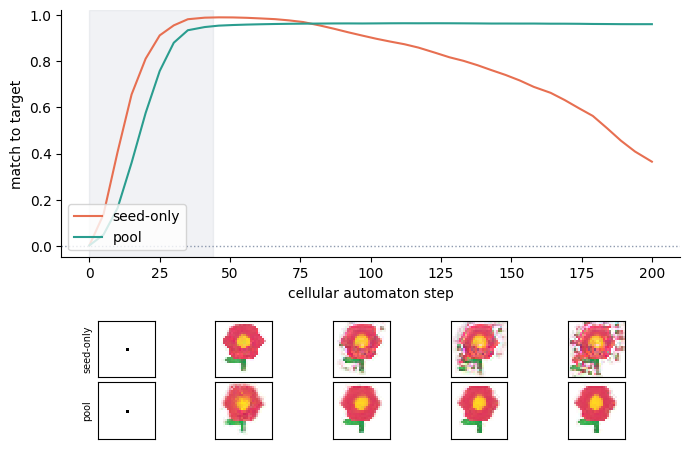
cellular automaton — شبكة خلايا تُحدَّث بالتوازي بقاعدة واحدة لا تقرأ إلا جواراً محلياً. لا خلية ترى الشبكة كاملة، ولا توجد في أي موضع خطوة تنظر إليها ككل.
عند الخطوة 200 · من البذرة 0.365 · من المجمّع 0.961
الفارق بينهما 0.596إذن قاعدة تبقى وأخرى لا تبقى، ولم تذكر أيٌّ من دالتَي الخسارة البقاء إطلاقاً. وهنا يجب أن نكون دقيقين. فمن المغري أن نستنتج أن تأتي مجاناً مع النمو، وهذا بالضبط ما تنفيه هذه التشغيلة. كلتا القاعدتين نمت. لكن إحداهما دُرِّبت فوق ذلك على حالات مكتملة النمو، وعلى بعض الحالات المثقوبة، ومن هنا جاء الثبات.
وهذا يمهّد للسؤال الأخير. القاعدة التي تحفظ شكلها ليست بالضرورة قادرة على إعادة بنائه. فالثبات والعودة سلوكان مختلفان، ولم يدخل توزيعَ التدريب إلا أحدهما. اقطع الزهرة نصفين وسترى.
أربع لوحات: الهدف، والزهرة بعد النمو، والزهرة وقد صُفِّر نصف شبكتها، ثم الحالة نفسها وقد تُركت تعمل. والمحو يطال القنوات كلها، بما فيها المخفية، فلا يبقى هيكل ناجٍ يُبنى عليه. على المنطقة إذن أن تُستعاد عبر حدودها، خليةً واحدة في كل خطوة. فما تراه ليس ترميماً لصورة من بقاياها، بل يزحف من الحدّ إلى الداخل. وتفقّد الورقة الخضراء تحديداً: لم تكن قط إلا في الجهة الممحوّة، فلا يمكن نسخها من الجهة المقابلة. فإن عادت في جهتها الصحيحة، فالقاعدة أعادت بناءها ولم تنقلها.
HEAL_STEPS = env.cfg["healSteps"]


def ar(text: str) -> str:
    """Join Arabic letters into their connected forms, then reorder for LTR drawing."""
    return get_display(arabic_reshaper.reshape(text))


def erase_half(state: torch.Tensor, side: str) -> torch.Tensor:
    """Zero one half of the grid, every channel — hidden ones included.

    Zeroing only RGBA would leave the rule's own signalling channels intact and
    the grid would rebuild from a scaffold that is still standing. Taking every
    channel is what makes this an ablation rather than a repaint.
    """
    cut = state.clone()
    half = GRID // 2
    if side == "left":
        cut[:, :, :, :half] = 0.0
    elif side == "right":
        cut[:, :, :, half:] = 0.0
    elif side == "top":
        cut[:, :, :half, :] = 0.0
    else:
        cut[:, :, half:, :] = 0.0
    return cut


torch.manual_seed(env.cfg["seed"])
stable, _ = roll_out(pool_rule, make_seed(1), GROW_STEPS)
stable_match = match(stable)

wounded = erase_half(stable, "left")
damaged_match = match(wounded)

healed, _ = roll_out(pool_rule, wounded, HEAL_STEPS)
healed_match = match(healed)
recovery = healed_match - damaged_match

fig, axes = plt.subplots(1, 4, figsize=(9, 2.6))
for axis, (state, label_en, label_ar) in zip(
    axes,
    (
        (target.unsqueeze(0), "target", "الهدف"),
        (stable, "grown", "بعد النمو"),
        (wounded, "half erased", "بعد المحو"),
        (healed, "healed", "بعد الترميم"),
    ),
):
    axis.imshow(to_rgb(state), interpolation="nearest")
    axis.set_title(ar(label_ar) if env.lang == "ar" else label_en, fontsize=9)
    axis.axis("off")
fig.tight_layout()
plt.show()

env.explain("regeneration")
if env.lang == "ar":
    print(
        f"بعد النمو {stable_match:.3f} · بعد المحو {damaged_match:.3f} "
        f"· بعد الترميم {healed_match:.3f}"
    )
    print(f"استعادت {recovery:.3f} خلال {HEAL_STEPS} خطوة")
else:
    print(f"grown {stable_match:.3f} · erased {damaged_match:.3f} · healed {healed_match:.3f}")
    print(f"recovered {recovery:.3f} in {HEAL_STEPS} steps")
regeneration — العودة إلى الهدف بعد إتلاف جزء من الحالة. وهو غير النمو، ولا تكتسبه القاعدة — كما تُظهر هذه التشغيلة — لمجرد إتقانها النمو.
بعد النمو 0.964 · بعد المحو 0.448 · بعد الترميم 0.871
استعادت 0.423 خلال 96 خطوةتمرين
لا شيء يُعاد تدريبه هنا. القاعدة ثابتة، وأنت تختار ما تفعله بزهرة مكتملة.
اختر جهةً تمحوها وعدداً من الخطوات تسمح بها. ثم ابحث عن حدود ما تقدر عليه هذه القاعدة، فهذا أكثر إفادة من رقم الاستعادة نفسه: جد قطعاً تعود منه تماماً، وقطعاً لا تعود منه أبداً. والثاني موجود. وحين تجده، فالسؤال ليس هل القاعدة ضعيفة، بل ماذا أزال ذلك القطع من الزهرة. تذكّر أن القاعدة لا تنقل المعلومة إلا خليةً واحدة في كل خطوة، وانطلاقاً من خلايا حيّة بالفعل.
# YOUR TURN.
#
# Nothing retrains here. The rule is fixed; you are choosing what to do to a
# grown flower and watching the same rule respond.
#
# SIDE     "left" | "right" | "top" | "bottom"
# STEPS    how long to let it run afterwards
#
# The defaults sit away from the graded run on purpose — a knob whose default
# happens to reproduce the checked number teaches nothing about the knob.
#
# Two questions worth more than the number: does the LEAF come back on the
# correct side when you erase the side it was on, and is there a side whose
# removal the rule cannot come back from at all?
SIDE = "bottom"
STEPS = HEAL_STEPS

torch.manual_seed(env.cfg["seed"])
your_stable, _ = roll_out(pool_rule, make_seed(1), GROW_STEPS)
your_wounded = erase_half(your_stable, SIDE)
your_healed, _ = roll_out(pool_rule, your_wounded, STEPS)

fig, axes = plt.subplots(1, 3, figsize=(6.6, 2.5))
for axis, state in zip(axes, (your_stable, your_wounded, your_healed)):
    axis.imshow(to_rgb(state), interpolation="nearest")
    axis.axis("off")
fig.tight_layout()
plt.show()

if env.lang == "ar":
    # SIDE stays an ASCII identifier value, but dropping it raw into Arabic
    # prose reverses the reading order around it. Named here instead.
    sides_ar = {"left": "اليسار", "right": "اليمين", "top": "الأعلى", "bottom": "الأسفل"}
    print(
        f"محو {sides_ar.get(SIDE, SIDE)} · بعد المحو {match(your_wounded):.3f} "
        f"· بعد {STEPS} خطوة {match(your_healed):.3f}"
    )
else:
    print(
        f"erased {SIDE} · after damage {match(your_wounded):.3f} · after {STEPS} steps {match(your_healed):.3f}"
)يتوفّر تلميح في الدفتر — env.hint(3)
نبدأ بالفحص الضابط، وعن قصد. فالنتيجة التي تعرضها الورشة هي أن قاعدة البذرة تبلغ الهدف ثم تغادره، والقاعدة التي لم تبلغه أصلاً لا يمكن أن تغادره. ومن دون هذا الفحص، قد تصف الأرقام الثلاثة الأخرى قاعدتين أخفقتا كلتاهما في تعلّم المهمة.
# The control goes FIRST and on purpose. If the seed-only rule never reached
# the flower at the horizon it was trained through, then it did not overshoot
# the flower either, and every comparison below would be between two rules that
# both simply failed to learn the task. If this check fails the answer is more
# training steps, never a lower bar.
naive_grows_ok = env.check("naive-grows", naive_match_trained)
target_match_ok = env.check("target-match", pool_match)
# Keyed on the pool rule's OWN match at the horizon, not on the gap between
# the two rules. Across two runs the gap moved 8.45 -> 0.63 while this number
# moved 0.81 -> 0.86: the gap's magnitude is mostly a measure of how badly the
# loser happens to fail on a given seed, which is not what the check is for.
# The gap is still captured and still quoted, as evidence rather than as a bar.
persists_ok = env.check("persists", pool_match_long)
recovers_ok = env.check("recovers", recovery)✓ تطابق قاعدة البذرة مع الهدف عند الأفق الذي دُرِّبت عبره: 0.9903 (المطلوب ≥ 0.85)
✓ تطابق القاعدة المدرَّبة بالمجمّع مع الهدف بعد نموّها من خلية واحدة: 0.9636 (المطلوب ≥ 0.75)
✓ تطابق القاعدة المدرَّبة بالمجمّع مع الهدف بعد الأفق الذي دُرِّبت عبره بكثير: 0.9607 (المطلوب ≥ 0.7)
✓ التطابق المستعاد بعد محو نصف الشبكة: 0.4228 (المطلوب ≥ 0.2)receipt = env.receipt()اكتملت الورشة.
رمز الإتمام: AZ-██████████
الصقه في صفحة الورشة على أزيموث لتسجيل إتمامها.مصطلحات هذه الورشة
- الآلة الخلويةCellular Automaton
- التشكل الحيويMorphogenesis
- قاعدة التحديثUpdate Rule
- مخزون العيناتSample Pool
- التجددRegeneration