الشبكات العصبيةintermediateمعالج رسوميات اختياري~25 دقيقةColab
الاستيعاب المتأخّر: هضبة تخدع قاعدة التوقّف
Grokking: the plateau your stopping rule would have believed
التأخير رقم تستطيع قياسه، والتوقّف المبكر يقطع التدريب في منتصفه
تخيّل أنك تدرّب نموذجاً صغيراً على مهمة تعرف أنه قادر على تعلّمها. خلال بضع مئات من الخطوات تصل على إلى الكمال، ثم تتوقّف عن الحركة. أما الدقة على فليست عند مستوى الصدفة، بل تحته. السبب أن النموذج الذي حفظ الأمثلة لا يخمّن عشوائياً فيما لم يره، بل يجيب بثقة إجابات خاطئة. وكل حدس عملي عندك يقول الشيء نفسه: لا شيء يتحسّن، أوقف التدريب وغيّر شيئاً ما.
هو ما يحدث إذا لم تفعل. بعد آلاف الخطوات، وبعد النقطة التي كان سيتوقّف عندها أي ممارس حريص بزمن طويل، تغادر دقة الاختبار مستوى الصدفة وتصعد حتى تقارب الكمال. عندها يكون النموذج قد انتقل من إلى .
الورقة البحثية تخبرك أن هذا يحدث، وقراءتها تكفي لتعرف ذلك. لكن هناك شيئين لا تعطيك إياهما القراءة. الأول: حجم هذه الفجوة على جهازك أنت. والثاني: أن قاعدة عادية، إذا طبّقتها على المنحنى الذي سجّلته بنفسك، ستوقف التدريب في منتصف الفجوة وتضيّع النتيجة.
الهدف
درّب محوّلاً صغيراً على <Term en="Modular Arithmetic">الجمع القياسي</Term> حتى يحفظ بيانات التدريب، ثم لا تتوقّف: واصل التدريب لفترة أطول بكثير. خلال ذلك قِس ثلاثة أشياء: الخطوة التي حفظ عندها النموذج، والخطوة التي عمّم عندها، وكم خطوة تفصل بينهما. بعد ذلك طبّق قاعدة توقّف مبكر عادية على المنحنى الذي سجّلته، واحسب كم خطوة كانت ستُهدر.
يفتح Colab نسخة للقراءة فقط. احفظ نسخة في Drive للاحتفاظ بتعديلاتك.
يحتاج الدفتر إلى لوحة مفاتيح — يُفضَّل فتحه على حاسوب مكتبي.
الأوراق وراء هذه الورشة
مكوّنات هذه الورشة عادية تقريباً. المهمة جمع عددين ثم أخذ باقي القسمة على عدد أوّلي، والنموذج كتلة واحدة، والورشة كلها تشغيلة تدريب واحدة نراقبها لوقت أطول مما نفعل عادةً. القيمة الوحيدة التي تستحق أن تتوقّف عندها هي : هي هنا أكبر من القيمة التي تذكرها معظم الشروحات. وبالقيمة المعتادة، تحفظ هذه التشغيلة نفسها البيانات ثم لا يحدث شيء لأربعين ألف خطوة.
اقرأ المنحنى على ثلاث مراحل. أولاً: ترتفع دقة التدريب حتى تبلغ سقفها، وهذا هو الحفظ. ثانياً: تهبط دقة الاختبار إلى الأرضية وتبقى هناك، وهذا هو الجزء الذي يبدو فشلاً. ثالثاً: تتحرّك.
خلال فترة هذه، راقب التدريب في اللوحة السفلى، فهي تواصل الانخفاض طوال الوقت. التشغيلة لم تنتهِ بعد، لكنها توقّفت عن إظهار أي تقدّم على المحور الذي كنت تراقبه.
تهيئة أولية. لا نطلب مسرّعاً هنا: النموذج صغير إلى حدّ أن طلب GPU سيكون مبالغة لا داعي لها.
import azimuth_nb as azimuth

env = azimuth.setup(SLUG, lang=LANG, profile=PROFILE)الاستيعاب المتأخر: الهضبة التي كانت قاعدة التوقّف لتصدّقها
بدون معالج رسوميات · ذاكرة 12.7 غ.ب · PyTorch 2.11.0+cpu
الملف: free
جاهز · modulus=47, trainFrac=0.6, dModel=64, nHeads=4, dFF=256, steps=14000, evalEvery=100, logEvery=1000, learningRate=0.001, weightDecay=2.0, memoriseAt=0.99, generaliseAt=0.9, seed=17
الشيفرة · 9fc593a2610292a0نعدّد كل الأزواج الممكنة في المهمة، ثم نقسمها مرة واحدة. لاحظ مستوى الصدفة المطبوع هنا واحتفظ به في ذهنك: هذه هي الدقة التي يحققها نموذج لا يعرف شيئاً. وخلال الهضبة كلها ستبقى دقة الاختبار تحت هذا المستوى. إذا قرأت ذلك على أنه عطل في التشغيلة، فقد وقعت في أول خطأ تريد هذه الورشة أن تجنّبك إياه.
import numpy as np

p = env.cfg["modulus"]

# Every pair the task admits, enumerated. This is what makes an algorithmic
# dataset useful here: "unseen" is exact rather than approximate, so the
# held-out number means what it says.
a_all, b_all = np.meshgrid(np.arange(p), np.arange(p), indexing="ij")
a_all, b_all = a_all.ravel(), b_all.ravel()

# Token p is the "=" that separates the operands from the answer position.
# Vocabulary is p operand tokens plus that one; the output layer predicts over
# the p possible answers only .
EQUALS = p
inputs = np.stack([a_all, b_all, np.full_like(a_all, EQUALS)], axis=1)
targets = (a_all + b_all) % p

rng = np.random.default_rng(env.cfg["seed"])

# THE SPLIT IS OVER UNORDERED PAIRS, NOT OVER ROWS.
#
# Addition commutes, so (a, b) and (b, a) have the same answer. Splitting the
# 3481 rows at random puts one ordering in training and the other in the
# held-out set for a large fraction of them, and a model that has merely
# MEMORISED the training row can answer its transpose. The first run of this
# workshop did exactly that: the held-out curve rose immediately to a plateau
# and sat there for thousands of steps, which read as partial generalization
# and was not.
#
# Grouping by the unordered pair and assigning whole groups keeps both
# orderings on the same side of the split. The `leakage` cell measures that it
# worked rather than assuming it.
lo, hi = np.minimum(a_all, b_all), np.maximum(a_all, b_all)
group = lo * p + hi

groups = rng.permutation(np.unique(group))
n_train_groups = round(env.cfg["trainFrac"] * len(groups))
train_groups = set(groups[:n_train_groups].tolist())
is_train = np.array([g in train_groups for g in group.tolist()])

train_in, test_in = inputs[is_train], inputs[~is_train]
train_out, test_out = targets[is_train], targets[~is_train]

n_train, n_test = len(train_in), len(test_in)

# Chance is one over the modulus, NOT zero. A held-out curve resting just
# above the axis is a model guessing uniformly, and mistaking that floor for
# zero makes the eventual jump look larger than it is.
chance = 1.0 / p

if env.lang == "ar":
    print(f"القياس {p} · {len(inputs)} زوجاً ممكناً")
    print(f"تدريب {n_train} · اختبار {n_test}")
    print(f"مستوى الصدفة {chance:.4f}")
else:
    print(f"modulus {p} · {len(inputs)} possible pairs")
    print(f"train {n_train} · test {n_test}")
print(f"chance level {chance:.4f}")القياس 47 · 2209 زوجاً ممكناً
تدريب 1323 · اختبار 886
مستوى الصدفة 0.0213عمليات على المجموعات فقط، ولا تدريب هنا. الرقم الأول هو عدد الأزواج المحجوزة التي يمكن حلّها بمجرد تبديل ترتيب زوج من بيانات التدريب، أي حجم ، ويجب أن يكون صفراً. الرقم الثاني نسبة: كم من الأزواج المحجوزة كان سيتسرّب لو قسمنا الصفوف عشوائياً. هذه النسبة، لا مستوى الصدفة، هي المستوى الذي كانت دقة الاختبار ستستقر عنده. ومنحنى يستقر هناك يبدو كأنه تقدّم بطيء، وهو ليس تقدّماً على الإطلاق.
# What the split gave away. Set arithmetic only — nothing trains here.
#
# `leaked_pairs` is how many held-out rows could be answered by transposing a
# row the model was trained on. It must be zero. `naive_leaked` is what a
# random split over rows would have handed over instead, and it is the height
# of the floor the held-out curve would have rested on: not chance, and not a
# result.
train_rows = set(zip(train_in[:, 0].tolist(), train_in[:, 1].tolist()))
test_rows = list(zip(test_in[:, 0].tolist(), test_in[:, 1].tolist()))
leaked_pairs = sum(1 for x, y in test_rows if (y, x) in train_rows)

naive_order = np.random.default_rng(env.cfg["seed"]).permutation(len(inputs))
naive_cut = int(env.cfg["trainFrac"] * len(inputs))
naive_train = set(
    zip(
        inputs[naive_order[:naive_cut], 0].tolist(),
        inputs[naive_order[:naive_cut], 1].tolist(),
    )
)
naive_test = list(
    zip(
        inputs[naive_order[naive_cut:], 0].tolist(),
        inputs[naive_order[naive_cut:], 1].tolist(),
    )
)
naive_leaked = sum(1 for x, y in naive_test if (y, x) in naive_train) / len(naive_test)

env.explain("leakage")
if env.lang == "ar":
    print(f"أزواج محجوزة يمكن الإجابة عنها بالتبديل: {leaked_pairs}")
    print(f"القسمة الساذجة على الصفوف كانت لتسلّم {naive_leaked:.3f} منها")
else:
    print(f"held-out pairs answerable by transposition: {leaked_pairs}")
    print(f"a naive split over rows would have handed over {naive_leaked:.3f} of them")

split_ok = env.check("split-is-clean", leaked_pairs)leakage — معلومات تصل إلى المجموعة المحجوزة من مجموعة التدريب. وهي تصل هنا عبر تناظر في المهمة لا عبر صف مكرَّر، ولذلك بدت القسمة عشوائية ولم تكن كذلك.
أزواج محجوزة يمكن الإجابة عنها بالتبديل: 0
القسمة الساذجة على الصفوف كانت لتسلّم 0.578 منها
✓ أزواج محجوزة يمكن الإجابة عنها بتبديل زوج تدريب: 0 (المطلوب ≤ 0)كتلة محوّل واحدة، صغيرة بما يكفي لتقرأ بنيتها كاملة. قارن عدد المعاملات بعدد أزواج التدريب المطبوع أعلاه: حفظ هذه الأزواج كلها في متناول النموذج بسهولة. وهذا بالتحديد سبب حدوث الهضبة الأولى.
import torch
import torch.nn as nn

torch.manual_seed(env.cfg["seed"])
device = torch.device("cuda" if torch.cuda.is_available() else "cpu")

SEQ_LEN = 3


class GrokFormer(nn.Module):
    """One pre-norm transformer block, reading the answer off the last position.

    Deliberately the smallest thing that groks rather than a scaled-down copy
    of anything. Depth is not the variable here — the training run is.
    """

    def __init__(self, vocab: int, d_model: int, n_heads: int, d_ff: int, n_answers: int):
        super().__init__()
        self.tok = nn.Embedding(vocab, d_model)
        self.pos = nn.Parameter(torch.randn(SEQ_LEN, d_model) * 0.02)
        self.ln1 = nn.LayerNorm(d_model)
        self.attn = nn.MultiheadAttention(d_model, n_heads, batch_first=True)
        self.ln2 = nn.LayerNorm(d_model)
        self.mlp = nn.Sequential(
            nn.Linear(d_model, d_ff),
            nn.GELU(),
            nn.Linear(d_ff, d_model),
        )
        self.unembed = nn.Linear(d_model, n_answers, bias=False)

    def forward(self, x):
        h = self.tok(x) + self.pos
        normed = self.ln1(h)
        h = h + self.attn(normed, normed, normed, need_weights=False)[0]
        h = h + self.mlp(self.ln2(h))
        return self.unembed(h[:, -1])


model = GrokFormer(
    vocab=p + 1,
    d_model=env.cfg["dModel"],
    n_heads=env.cfg["nHeads"],
    d_ff=env.cfg["dFF"],
    n_answers=p,
).to(device)

param_count = sum(w.numel() for w in model.parameters())

env.explain("memorization")
if env.lang == "ar":
    print(f"{param_count:,} معامل مقابل {n_train} زوج تدريب")
else:
print(f"{param_count:,} parameters against {n_train} training pairs")memorization — ملاءمة أمثلة التدريب دون تعلّم قاعدة تغطي ما لم يُرَ منها. كمال على ما رآه، وصدفة على كل ما عداه.
56,256 معامل مقابل 1323 زوج تدريبهذا هو الجزء الطويل. أثناء التشغيل ستبقى دقة الاختبار عند مستوى الصدفة أو تحته. السبب أن النموذج الذي حفظ الأمثلة لا يخطئ عشوائياً فيما لم يره، بل يخطئ بثقة. لذلك اعتبر أي رقم تحت خط الصدفة قراءة متوقّعة، لا خللاً في الكود. بعد القفزة، توقّع هبوطات مفاجئة بين حين وآخر: تسقط دقة التدريب لتقييم أو اثنين، وتسقط معها دقة الاختبار. هذا شدّ وجذب بين اضمحلال الأوزان والخسارة، ولهذا يعتمد الفحص أدناه على أعلى قيمة بلغتها الدقة، لا على آخر قيمة.
import time

train_x = torch.from_numpy(train_in).long().to(device)
train_y = torch.from_numpy(train_out).long().to(device)
test_x = torch.from_numpy(test_in).long().to(device)
test_y = torch.from_numpy(test_out).long().to(device)

# Full batch. The dataset fits in memory many times over, and a fixed batch
# removes sampling noise from an axis where a long flat line is the evidence.
optimizer = torch.optim.AdamW(
    model.parameters(),
    lr=env.cfg["learningRate"],
    weight_decay=env.cfg["weightDecay"],
    betas=(0.9, 0.98),
)
criterion = nn.CrossEntropyLoss()


def accuracy(x, y) -> float:
    model.eval()
    with torch.no_grad():
        return float((model(x).argmax(dim=-1) == y).float().mean())


steps_log: list[int] = []
train_acc_log: list[float] = []
test_acc_log: list[float] = []
train_loss_log: list[float] = []

# The two crossings, recorded as they happen rather than reconstructed later:
# the first step at which the model has memorised, and the first at which it
# has generalised. Both stay None if the crossing never occurs, which is a
# distinct state from "crossed at step 0" and must not be flattened into it.
memorise_step = None
generalise_step = None

started = time.time()
model.train()
for step in range(1, env.cfg["steps"] + 1):
    optimizer.zero_grad()
    loss = criterion(model(train_x), train_y)
    loss.backward()
    optimizer.step()
    # .detach() before the scalar conversion: float() on a tensor that still
    # tracks gradients emits a UserWarning, and warnings printed inside a
    # training loop end up on the published page next to the numbers.
    loss_value = loss.detach().item()

    if step == 1 or step % env.cfg["evalEvery"] == 0:
        train_acc = accuracy(train_x, train_y)
        test_acc = accuracy(test_x, test_y)
        model.train()

        steps_log.append(step)
        train_acc_log.append(train_acc)
        test_acc_log.append(test_acc)
        train_loss_log.append(loss_value)

        if memorise_step is None and train_acc >= env.cfg["memoriseAt"]:
            memorise_step = step
        if generalise_step is None and test_acc >= env.cfg["generaliseAt"]:
            generalise_step = step

        if step == 1 or step % env.cfg["logEvery"] == 0:
            elapsed = time.time() - started
            print(
                f"step {step:6d}  train {train_acc:.3f}  test {test_acc:.3f}  "
                f"loss {loss_value:.5f}  {elapsed:5.0f}s"
            )

peak_train_acc = max(train_acc_log)
final_test_acc = test_acc_log[-1]
# The PEAK held-out accuracy, not the last one. At this decay the run keeps
# taking optimization spikes after it has generalised: training accuracy drops
# to around 0.92 for an evaluation or two and the held-out figure falls with
# it. Two measured seeds peaked at 0.937 and 0.917 and both happened to end
# near 0.90, so a check on the final value is really a check on where the
# oscillation was standing when the budget ran out.
peak_test_acc = max(test_acc_log)

env.explain("weight decay")
if env.lang == "ar":
    print(
        f"أعلى دقة تدريب {peak_train_acc:.3f} · أعلى دقة محجوزة {peak_test_acc:.3f} "
        f"· الدقة النهائية {final_test_acc:.3f}"
    )
    print(f"حفظ عند {memorise_step} · عمّم عند {generalise_step}")
else:
    print(
        f"peak train {peak_train_acc:.3f} · peak unseen {peak_test_acc:.3f} "
        f"· final unseen {final_test_acc:.3f}"
    )
print(f"memorised at {memorise_step} · generalised at {generalise_step}")step 1 train 0.020 test 0.018 loss 3.98689 0s
step 1000 train 1.000 test 0.000 loss 0.16864 59s
step 2000 train 1.000 test 0.002 loss 0.04802 117s
step 3000 train 1.000 test 0.000 loss 0.08134 176s
step 4000 train 1.000 test 0.025 loss 0.06125 236s
step 5000 train 1.000 test 0.335 loss 0.05982 294s
step 6000 train 1.000 test 0.416 loss 0.07515 353s
step 7000 train 1.000 test 0.710 loss 0.06052 411s
step 8000 train 1.000 test 0.841 loss 0.02337 471s
step 9000 train 1.000 test 0.896 loss 0.04213 528s
step 10000 train 1.000 test 0.921 loss 0.03648 588s
step 11000 train 0.833 test 0.676 loss 0.57979 647s
step 12000 train 1.000 test 0.921 loss 0.02582 706s
step 13000 train 1.000 test 0.930 loss 0.02328 764s
step 14000 train 1.000 test 0.923 loss 0.01406 824s
weight decay — شدٌّ لكل معامل نحو الصفر يُطبَّق في كل خطوة. يسعّر التعقيد، وهو هنا ما يجعل الحل العام في النهاية أرخص من المحفوظ.
أعلى دقة تدريب 1.000 · أعلى دقة محجوزة 0.938 · الدقة النهائية 0.923
حفظ عند 300 · عمّم عند 9200محور الدقة يبدأ من الصفر حتى تبدو الفترة المستوية مستوية فعلاً. ومحور الخطوات لوغاريتمي لأن الفجوة تمتد عبر عدة مراتب عشرية. أثناء فترة الثبات في اللوحة العليا، انظر إلى اللوحة السفلى: هناك ما يتحرّك.
import matplotlib.pyplot as plt

# A gap of 0 is what an incomplete run produces: either crossing missing means
# there is nothing to measure. Reporting 0 rather than skipping the number
# makes the `delay` check FAIL, which is the honest outcome — a run that never
# grokked should not certify a delay.
if memorise_step is not None and generalise_step is not None:
    grok_gap = generalise_step - memorise_step
else:
    grok_gap = 0

fig, (top, bottom) = plt.subplots(2, 1, figsize=(7, 5.4), sharex=True)

top.plot(steps_log, train_acc_log, label="train", color="#2a9d8f")
top.plot(steps_log, test_acc_log, label="held out", color="#e76f51")
top.axhline(chance, color="#8d99ae", linestyle=":", linewidth=1, label="chance")
# Zero-based: the long flat stretch is the argument, and an autoscaled axis
# would turn the noise on it into a trend.
top.set_ylim(0, 1.02)
top.set_ylabel("accuracy")
top.legend(loc="center left")
top.spines[["top", "right"]].set_visible(False)

bottom.plot(steps_log, train_loss_log, color="#264653")
bottom.set_yscale("log")
bottom.set_ylabel("train loss")
bottom.set_xlabel("optimizer step")
bottom.spines[["top", "right"]].set_visible(False)

for axis in (top, bottom):
    # Logarithmic in the step axis because the delay spans orders of
    # magnitude; on a linear axis the whole first plateau is one pixel wide.
    axis.set_xscale("log")
    if memorise_step is not None:
        axis.axvline(memorise_step, color="#2a9d8f", linewidth=1, alpha=0.5)
    if generalise_step is not None:
        axis.axvline(generalise_step, color="#e76f51", linewidth=1, alpha=0.5)

fig.tight_layout()
plt.show()

env.explain("grokking")
if env.lang == "ar":
    print(f"الفجوة {grok_gap} خطوة بين الحفظ والتعميم")
else:
    print(f"gap of {grok_gap} steps between memorising and generalising")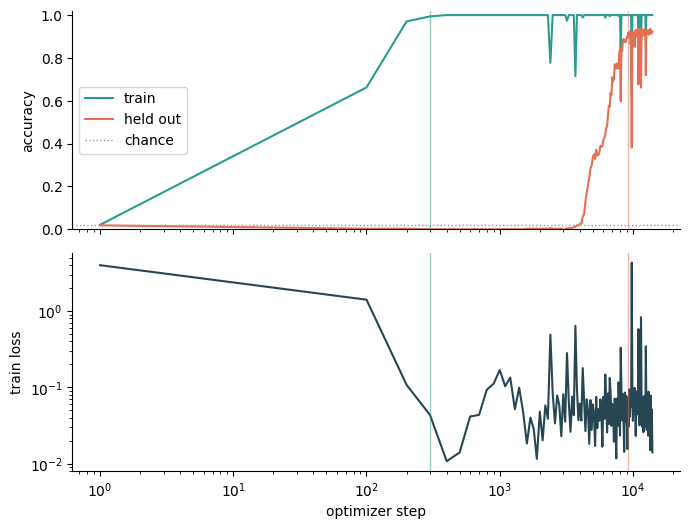
grokking — تعميم يصل بعد أن تكفّ خسارة التدريب عن كونها مثيرة للاهتمام بزمن طويل. صفة لمسار التدريب لا للنموذج النهائي.
الفجوة 8900 خطوة بين الحفظ والتعميمتمرين
اختر قيمة للصبر (patience) وانظر كم تكلّفك. القاعدة أدناه هي القاعدة المعتادة: راقب دقة الاختبار، وأوقف التدريب إذا لم تتحسّن لعدد معيّن من التقييمات. لا نعيد التدريب هنا: الخلية تمرّ على المنحنى الذي سجّلته من قبل، تقييماً بعد تقييم.
اختر الصبر الذي كنت ستستخدمه فعلاً قبل أن ترى هذا الشكل. ثم اقرأ الخطوة التي توقف القاعدة التدريب عندها، وكم خطوة تفصلها عن القفزة. بعدها اسأل السؤال الأصعب: ماذا كان عليك أن تراقب بدلاً من الدقة حتى لا تخطئ القاعدة؟ في هذه التشغيلة مقياس ظلّ يتحرّك طوال الهضبة، وتجده في اللوحة السفلى.
# YOUR TURN.
#
# The ordinary rule: watch held-out accuracy, stop when it has not improved
# for PATIENCE consecutive evaluations. Nothing retrains — this replays the
# curve already logged above.
#
# Patience is counted in EVALUATIONS. Multiply by the eval interval to get the
# number of optimizer steps it actually buys you, which is usually smaller
# than it sounds.
PATIENCE = 20

best_acc = -1.0
stale = 0
stopped_at = steps_log[-1]
for step, acc in zip(steps_log, test_acc_log):
    if acc > best_acc:
        best_acc, stale = acc, 0
    else:
        stale += 1
        if stale >= PATIENCE:
            stopped_at = step
            break

patience_steps = PATIENCE * env.cfg["evalEvery"]
reached = generalise_step if generalise_step is not None else steps_log[-1]
discarded = max(0, reached - stopped_at)

if env.lang == "ar":
    print(f"صبر {PATIENCE} تقييماً = {patience_steps} خطوة")
    print(f"كانت القاعدة لتتوقف عند الخطوة {stopped_at} بدقة محجوزة {best_acc:.3f}")
    print(f"خطوات مهدورة قبل القفزة: {discarded}")
else:
    print(f"patience of {PATIENCE} evaluations = {patience_steps} steps")
    print(f"the rule would have stopped at step {stopped_at}, held-out {best_acc:.3f}")
print(f"steps discarded before the jump: {discarded}")يتوفّر تلميح في الدفتر — env.hint(4)
نفحص الحفظ أولاً وعن قصد. من دونه لا توجد هضبة تفاجئك أصلاً، وأي تأخير نقيسه على تشغيلة لم تتعلّم شيئاً سيكون رقماً بلا معنى.
# The control goes first. Without memorisation there is no plateau, and a
# delay measured on a run that never fit the training set would be a number
# about nothing.
memorises_ok = env.check("memorises", peak_train_acc)
generalises_ok = env.check("generalises", peak_test_acc)
delay_ok = env.check("delay", grok_gap)✓ أعلى دقة على أزواج التدريب: 1 (المطلوب ≥ 0.99)
✓ أفضل دقة بلغتها الأزواج المحجوزة: 0.9379 (المطلوب ≥ 0.85)
✓ خطوات المحسِّن بين الحفظ والتعميم: 8900 (المطلوب ≥ 4000)receipt = env.receipt()اكتملت الورشة.
رمز الإتمام: AZ-██████████
الصقه في صفحة الورشة على أزيموث لتسجيل إتمامها.مصطلحات هذه الورشة
- الاستيعاب المتأخّرGrokking
- الحفظMemorization
- اضمحلال الأوزانWeight Decay
- الإيقاف المبكر للتدريبEarly Stopping
- الحساب المعياريModular Arithmetic