Systems & ScaleintermediateGPU~40 minColab
Quantization: what int8 and int4 actually cost
التكميم: الثمن الحقيقي لـ int8 و int4
Three costs, and the one you did not budget for goes backwards
is the cheapest win in : store the weights in fewer bits, and the model fits on hardware that could not hold it before. The papers tell you it works. What they cannot tell you is what YOUR model loses, because the answer depends on the model, the data, and where in the network the precision was spent.
So the interesting question is not "does int4 work" — it is which of the three costs actually moves. Memory falls, predictably. Quality barely moves at all, which is the papers working. And does something no summary prepares you for: it can get WORSE, and not even in bit order. Measure all three and the deployment decision stops being obvious.
The goal
Measure perplexity, memory and latency for the same model at fp16, int8 and int4, plot the three against each other, and identify which of the three costs moves first and which barely moves at all.
Colab opens a read-only copy. Save a copy to Drive to keep your edits.
The notebook needs a keyboard — best opened on a desktop.
The papers behind this
Three numbers move when you quantize, and they do not move together. Memory falls roughly with the bit count, and that part is arithmetic. Quality falls too, but not smoothly — it barely moves for a while and then falls off. Latency is the one that surprises people, because it can go the wrong way entirely.
Measuring all three at once is the point. A paper reporting only is not hiding anything; it is answering a different question from the one you have when you are deciding what to deploy.
Preflight. This is the first workshop here that genuinely needs a GPU — int8 and int4 kernels are CUDA only.
import azimuth_nb as azimuth

env = azimuth.setup(SLUG, lang=LANG, profile=PROFILE)Quantization: what int8 and int4 actually cost
Tesla T4 · 14.6 GB · 12.7 GB RAM · PyTorch 2.11.0+cu128
profile: free
ready · model=facebook/opt-350m, evalTokens=40000, latencyRuns=20, newTokens=64, seed=17
code · 6de6a8c98dc1a822Build the evaluation windows ONCE, before any model loads. Every variant is scored on identical text — a different sample per model would hide a real regression inside sampling noise.
import torch
from datasets import load_dataset
from transformers import AutoTokenizer

MODEL = env.cfg["model"]
tokenizer = AutoTokenizer.from_pretrained(MODEL)

# BUILD THE WINDOWS ONCE, BEFORE ANY MODEL LOADS.
#
# Every variant is scored on byte-identical text. Re-sampling per model would
# put sampling noise on the same axis as the effect being measured, and a real
# int4 regression could hide inside it — the numbers would still look precise.
# `Salesforce/wikitext`, not bare `wikitext`: the Hub now requires the owning
# org for this dataset, and the bare name resolves to nothing. Exactly the
# volatile-tier rot this workshop exists to demonstrate the pinning for .
raw = load_dataset("Salesforce/wikitext", "wikitext-2-raw-v1", split="test")
text = "\n\n".join(t for t in raw["text"] if t.strip())
all_ids = tokenizer(text, return_tensors="pt").input_ids[0][: env.cfg["evalTokens"]]

WINDOW = 512
windows = [all_ids[i : i + WINDOW] for i in range(0, len(all_ids) - WINDOW, WINDOW)]
n_windows = len(windows)

if env.lang == "ar":
    print(f"النموذج: {MODEL}")
    print(f"نوافذ التقييم: {n_windows} نافذة × {WINDOW} رمز")
else:
    print(f"model: {MODEL}")
print(f"eval windows: {n_windows} × {WINDOW} tokens")model: facebook/opt-350m
eval windows: 78 × 512 tokensThree loads, three measurements each. The model is freed between variants so the memory figure is the model, not the leftovers.
import gc
import time

from transformers import AutoModelForCausalLM, BitsAndBytesConfig


def load(variant):
    """One model, three ways. Only the dtype/quantization config differs."""
    if variant == "fp16":
        # `dtype`, not `torch_dtype` — renamed in transformers 5. The old name
        # still works and warns, which is exactly how a workshop keeps running
        # for a year and then stops.
        kwargs = {"dtype": torch.float16}
    elif variant == "int8":
        kwargs = {"quantization_config": BitsAndBytesConfig(load_in_8bit=True)}
    else:
        kwargs = {
            "quantization_config": BitsAndBytesConfig(
                load_in_4bit=True,
                # NF4 rather than plain int4: GPTQ's lesson is that WHERE the
                # levels sit matters as much as how many there are.
                bnb_4bit_quant_type="nf4",
                bnb_4bit_compute_dtype=torch.float16,
            )
        }
    return AutoModelForCausalLM.from_pretrained(MODEL, device_map="cuda:0", **kwargs)


def perplexity(model):
    """Mean NLL over the shared windows, exponentiated."""
    model.eval()
    total, count = 0.0, 0
    with torch.no_grad():
        for window in windows:
            ids = window.unsqueeze(0).to("cuda:0")
            loss = model(ids, labels=ids).loss
            total += loss.item() * ids.numel()
            count += ids.numel()
    return float(torch.exp(torch.tensor(total / count)))


def footprint(model):
    """Megabytes of parameters as actually stored, not as declared.

    Reading nelement * element_size per parameter is the honest measure: a
    4-bit tensor reports element_size 1 with two values packed per byte, so
    counting declared dtypes would overstate int4 by exactly the factor the
    workshop is trying to measure.
    """
    return sum(p.nelement() * p.element_size() for p in model.parameters()) / 1024**2


def latency(model, runs, new_tokens):
    """Median milliseconds per generated token, single sequence."""
    prompt = windows[0][:64].unsqueeze(0).to("cuda:0")
    with torch.no_grad():  # warm the kernels before timing anything
        model.generate(prompt, max_new_tokens=8, do_sample=False)
    torch.cuda.synchronize()
    times = []
    for _ in range(runs):
        start = time.perf_counter()
        with torch.no_grad():
            model.generate(prompt, max_new_tokens=new_tokens, do_sample=False)
        torch.cuda.synchronize()
        times.append((time.perf_counter() - start) * 1000 / new_tokens)
    times.sort()
    return times[len(times) // 2]


results = {}
peak_gb = 0.0
for variant in ("fp16", "int8", "int4"):
    # Reset before each variant so the peak is THIS model's, not a high-water
    # mark left by the previous one.
    torch.cuda.reset_peak_memory_stats()
    model = load(variant)
    results[variant] = {
        "ppl": perplexity(model),
        "mb": footprint(model),
        "ms": latency(model, env.cfg["latencyRuns"], env.cfg["newTokens"]),
    }
    # PEAK allocated, not the weight footprint. The weights are under a
    # gigabyte; what actually decides whether this fits on a card is the
    # activations and the KV cache during generate. Reporting it turns the
    # profile's `vramGb` from a guess into a measurement — the first version
    # declared 14 GB because that is what a T4 has, which locked out every
    # 8 GB card for no reason.
    variant_peak = torch.cuda.max_memory_allocated() / 1024**3
    peak_gb = max(peak_gb, variant_peak)
    print(
        f"  {variant:5} ppl {results[variant]['ppl']:7.3f}"
        f"  {results[variant]['mb']:8.1f} MB"
        f"  {results[variant]['ms']:6.1f} ms/token"
        f"  peak {variant_peak:4.1f} GB"
    )
    # Freed between variants so the memory figure is the model, not leftovers.
    del model
    gc.collect()
    torch.cuda.empty_cache()

if env.lang == "ar":
    print(f"\nذروة ذاكرة المعالج: {peak_gb:.1f} غ.ب — هذا ما ينبغي أن يعلنه vramGb")
else:
    print(f"\npeak VRAM: {peak_gb:.1f} GB — this is what `vramGb` should declare")

fp16_ppl, int8_ppl, int4_ppl = (results[v]["ppl"] for v in ("fp16", "int8", "int4"))
fp16_mb, int8_mb, int4_mb = (results[v]["mb"] for v in ("fp16", "int8", "int4")) fp16 ppl 34.655 631.7 MB 14.8 ms/token peak 0.9 GB
int8 ppl 34.705 342.7 MB 59.6 ms/token peak 0.6 GB
/usr/local/lib/python3.13/dist-packages/bitsandbytes/backends/cuda/ops.py:447: FutureWarning: _check_is_size will be removed in a future PyTorch release along with guard_size_oblivious. Use _check(i >= 0) instead.
torch._check_is_size(blocksize)
int4 ppl 37.839 198.2 MB 26.0 ms/token peak 0.5 GB
peak VRAM: 0.9 GB — this is what `vramGb` should declareThree costs on one figure, all zero-based so a flat line looks flat. Two of these fall the way you expect. The third is the workshop.
import matplotlib.pyplot as plt

memory_ratio = fp16_mb / int4_mb
ppl_ratio_int8 = int8_ppl / fp16_ppl
ppl_ratio_int4 = int4_ppl / fp16_ppl

variants = ["fp16", "int8", "int4"]
fig, axes = plt.subplots(1, 3, figsize=(9, 2.8))
for ax, key, title in zip(
    axes,
    ["ppl", "mb", "ms"],
    ["perplexity", "memory (MB)", "ms / token"],
):
    values = [results[v][key] for v in variants]
    ax.plot(variants, values, marker="o", color="#457b9d")
    ax.set_title(title, fontsize=10)
    ax.spines[["top", "right"]].set_visible(False)
    # Zero-based so a flat line LOOKS flat. Autoscaled axes turn a 1% change
    # into a dramatic slope, which is how a chart lies without a wrong number
    # anywhere in it.
    ax.set_ylim(0, max(values) * 1.2)
fig.tight_layout()
plt.show()

if env.lang == "ar":
    print(f"الذاكرة: النصفية أكبر بـ {memory_ratio:.2f}× من الرباعية")
    print(f"الحيرة: ثمانية {ppl_ratio_int8:.3f}× · رباعية {ppl_ratio_int4:.3f}×")
else:
    print(f"memory: fp16 is {memory_ratio:.2f}× larger than int4")
    print(f"perplexity: int8 {ppl_ratio_int8:.3f}× · int4 {ppl_ratio_int4:.3f}×")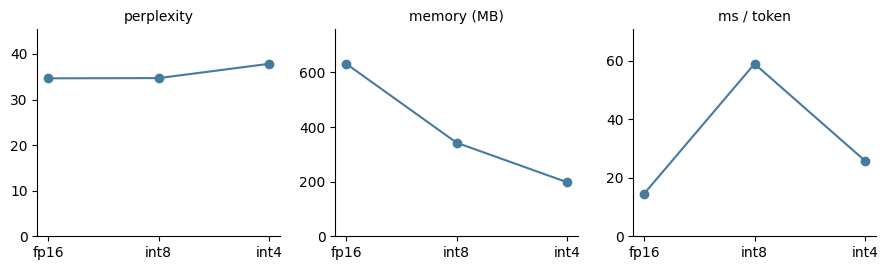
memory: fp16 is 3.19× larger than int4
perplexity: int8 1.001× · int4 1.092×
The one that goes the wrong way — and check the ORDER, not just the direction. If a variant with more bits is faster than one with fewer, the cost is not the bits, it is what the kernel has to do around them.
fp16_ms, int8_ms, int4_ms = (results[v]["ms"] for v in ("fp16", "int8", "int4"))

# Report the direction AND the order. The measured surprise is not just that
# quantized is slower — it is that int8 is slower than int4, i.e. the cost
# does not follow the bit count at all.
#
# int8 here runs LLM.int8()'s mixed-precision decomposition: outlier columns
# are split out and computed in fp16, then recombined. That is what buys the
# near-perfect quality two cells up, and it is not free. NF4 does a plainer
# dequantize-and-matmul and lands between the two.
slowest = max(("fp16", fp16_ms), ("int8", int8_ms), ("int4", int4_ms), key=lambda x: x[1])
if env.lang == "ar":
    print(
        f"زمن الاستجابة: نصفية {fp16_ms:.1f} · ثمانية {int8_ms:.1f} · رباعية {int4_ms:.1f} م.ث/رمز"
    )
    verdict = "أبطأ" if int4_ms > fp16_ms else "أسرع"
    print(
        f"الرباعية {verdict} من النصفية بعامل {max(int4_ms, fp16_ms) / min(int4_ms, fp16_ms):.2f}"
    )
else:
    print(f"latency: fp16 {fp16_ms:.1f} · int8 {int8_ms:.1f} · int4 {int4_ms:.1f} ms/token")
    verdict = "SLOWER" if int4_ms > fp16_ms else "faster"
    print(f"int4 is {verdict} than fp16 by {max(int4_ms, fp16_ms) / min(int4_ms, fp16_ms):.2f}×")
    if slowest[0] != "int4":
        print(
            f"and the slowest is not the smallest — it is {slowest[0]}. The cost is not the bits."
)latency: fp16 14.8 · int8 59.6 · int4 26.0 ms/token
int4 is SLOWER than fp16 by 1.75×
and the slowest is not the smallest — it is int8. The cost is not the bits.Exercise
Choose a variant for a stated deployment, and defend it with your own numbers rather than the defaults. Write down the constraint first — "fits in 8 GB", "under 50 ms per token", "quality within 2% of " — then read the table and pick.
Then notice what the exercise did to you. Given one number you optimise it; given three you have to state a constraint, and the constraint is a product decision, not a technical one. Which of the three would you never trade, and would your answer change for a chatbot versus a batch summarizer?
# YOUR TURN.
#
# State the constraint BEFORE reading the table. Then let the table choose.
# Chosen to sit AWAY from the measured values, not on top of them. A 60 ms
# ceiling put int8 at 58.5 on one run and 62.8 on another, so the two language
# builds of this page disagreed about which variant was viable — from timing
# noise, on identical code. A default that flips on noise teaches that the
# method is unreliable rather than that the choice is yours.
BUDGET_MB = 400
MAX_MS_PER_TOKEN = 80
MAX_PPL_RATIO = 1.05

viable = [
    v
    for v in variants
    if results[v]["mb"] <= BUDGET_MB
    and results[v]["ms"] <= MAX_MS_PER_TOKEN
    and results[v]["ppl"] / fp16_ppl <= MAX_PPL_RATIO
]
print(f"viable under your constraints: {viable or 'none — loosen one, and say which'}")A hint is available in the notebook — env.hint(2)
Memory must actually fall, and int8 must actually survive. If int8 moved a lot, hint 3 is the reason.
memory_ok = env.check("memory-falls", memory_ratio)
quality_ok = env.check("quality-survives-int8", ppl_ratio_int8)✓ Memory saved by int4, as a multiple of fp16: 3.187 (needs ≥ 1.5)
✓ int8 perplexity, relative to fp16: 1.001 (needs ≥ 0.85 and ≤ 1.15)receipt = env.receipt()Workshop complete.
Completion code: AZ-██████████
Paste it on the workshop's page on Azimuth to record it.Terms in this workshop
- Quantizationالتكميم
- Perplexityمعيار الحيرة الاحتمالية
- Dequantizationفك التكميم