Neural NetworksintermediateGPU~15 minColab
Growing neural cellular automata: the target is a waypoint, not a fixed point
أوتوماتا خلوية عصبية تنمو: الهدف محطة عبور لا نقطة استقرار
Persistence is bought by which states you train from, not by what the loss asks for
A single cell sits at the centre of an empty grid. One small convolutional rule — a few thousand parameters, shared by every cell, seeing nothing but its own channels and a three-by-three neighbourhood — is applied to the whole grid, over and over. Nothing is told where the edges of the shape should be. Nothing counts steps. Nothing holds a plan. After a few dozen applications there is a flower.
That much is the paper's result, and reading it is enough to learn it. What reading does not tell you is what happens on step one hundred. Train the obvious way — start from the seed, run the rule for a few dozen steps, ask the output to look like the target — and you get a rule that arrives at the flower and then keeps going, because nothing in that objective ever mentioned staying. The target was a waypoint the passed through, not an it settles at.
This workshop trains two rules that differ in exactly one respect: which states each training batch starts from. Same architecture, same initial weights, same optimizer, same budget, same loss, character for character. One starts every batch from the seed. The other starts from states it produced earlier, some of which have had a hole punched in them. At the horizon they were trained through, the seed-only rule is the better of the two: lower loss, and a closer match to the flower. Four times further out it has slid to a match of 0.292 while the other still holds 0.977 — and only one of them, cut in half, comes back.
The goal
Train both rules, watch the flower grow from one cell, then measure three things the loss never asked for: how well each rule matches the target far past the horizon it was trained through, the gap between them there, and how much of the target a grown flower recovers after half the grid is erased.
Colab opens a read-only copy. Save a copy to Drive to keep your edits.
The notebook needs a keyboard — best opened on a desktop.
The papers behind this
The model is small enough to hold in your head. Each cell carries a handful of numbers, four of which are drawn on the screen as colour and transparency and the rest of which mean nothing in particular — the rule decides what to keep there. At every step, each cell looks at itself and its eight neighbours through three fixed filters, passes the result through two layers, and adds the output to its own state. That is the entire model. The same weights run on every cell.
Two things in it are worth pausing on, because both are load-bearing and neither is obvious. The output layer starts at exactly zero, so the untrained rule is the identity and growth has to be learned rather than rescued from an explosion. And cells fire independently at random rather than all at once, because a grid that steps in lockstep has a global clock, and a global clock is the coordination this model is supposed to do without.
Preflight. No accelerator is requested — a few thousand parameters over a few hundred cells does not need one, and asking would be theatre.
import arabic_reshaper
import azimuth_nb as azimuth
from bidi.algorithm import get_display

env = azimuth.setup(SLUG, lang=LANG, profile=PROFILE)The shape is drawn, not downloaded, so nothing here can rot. Note that it is asymmetric: the leaf sits on one side of the stem and nowhere else. A symmetric target would let the damage run at the end succeed by mirroring instead of rebuilding, and the number would look the same. Keep the empty-grid error printed below — every score in this workshop is measured against it.
import matplotlib.pyplot as plt
import numpy as np
import torch

GRID = env.cfg["grid"]

# The target is DRAWN, not downloaded. That keeps the maintenance tier stable:
# there is no URL to rot, no licence to track, and no asset to pin. It also
# means the shape can be resized with the profile instead of being resampled.


def make_target(grid: int) -> np.ndarray:
    """An asymmetric flower, as premultiplied RGBA in (4, grid, grid).

    Asymmetric ON PURPOSE. A radially symmetric target can be rebuilt from any
    surviving wedge, so a damage run against one would look like regeneration
    while only testing symmetry. Here the leaf sits left of the stem and
    nowhere else, so erasing the left half removes information that has to be
    reconstructed rather than copied from across an axis.
    """
    rgba = np.zeros((4, grid, grid), dtype=np.float32)
    yy, xx = np.mgrid[0:grid, 0:grid].astype(np.float32)
    cx, cy = (grid - 1) / 2.0, grid * 0.36

    def disc(px, py, r):
        return ((xx - px) ** 2 + (yy - py) ** 2) <= r * r

    petal_r, ring_r = grid * 0.145, grid * 0.20
    petals = np.zeros((grid, grid), dtype=bool)
    for k in range(6):
        angle = 2 * np.pi * k / 6
        petals |= disc(cx + ring_r * np.cos(angle), cy + ring_r * np.sin(angle), petal_r)
    centre = disc(cx, cy, grid * 0.115)

    stem = (np.abs(xx - cx) <= grid * 0.035) & (yy >= cy + grid * 0.10) & (yy <= grid * 0.86)
    lx, ly = cx - grid * 0.17, grid * 0.68
    leaf = (((xx - lx) / (grid * 0.14)) ** 2 + ((yy - ly) / (grid * 0.062)) ** 2) <= 1.0

    # Painted back to front, so the stem never cuts through the yellow centre.
    for mask, colour in (
        (stem, (0.20, 0.56, 0.28)),
        (leaf, (0.24, 0.66, 0.32)),
        (petals & ~centre, (0.86, 0.24, 0.36)),
        (centre, (0.98, 0.78, 0.18)),
    ):
        for channel in range(3):
            rgba[channel][mask] = colour[channel]
        rgba[3][mask] = 1.0

    rgba[:3] *= rgba[3]  # premultiplied: RGB is only meaningful where alpha is
    return rgba


device = torch.device("cuda" if torch.cuda.is_available() else "cpu")
target = torch.from_numpy(make_target(GRID)).to(device)

# THE DENOMINATOR OF EVERY SCORE BELOW, and the reason the scores mean
# anything. An empty grid is not a neutral prediction: the target is mostly
# transparent background, so a rule that dies immediately scores well on plain
# pixel error. Dividing by the error an EMPTY grid makes pins the empty run at
# exactly zero and a perfect run at one.
empty_error = float((target**2).mean())


def match(state: torch.Tensor) -> float:
    """How much of the target a state accounts for. Empty grid 0, perfect 1.

    Deliberately not clipped below zero. A rule that has overshot into noise is
    WORSE than one that never grew, and flattening that to zero would hide the
    failure this workshop is built to show.
    """
    error = float(((state[:, :4] - target) ** 2).mean())
    return 1.0 - error / empty_error


def to_rgb(state: torch.Tensor) -> np.ndarray:
    """Composite premultiplied RGBA over white, for display."""
    rgba = state[0, :4].detach().cpu().numpy() if state.dim() == 4 else state[:4].cpu().numpy()
    rgb, alpha = rgba[:3], np.clip(rgba[3], 0, 1)
    return np.clip(1.0 - alpha + rgb, 0, 1).transpose(1, 2, 0)


alive_fraction = float((target[3] > 0.1).float().mean())

fig, axis = plt.subplots(figsize=(2.6, 2.6))
axis.imshow(to_rgb(target), interpolation="nearest")
axis.axis("off")
fig.tight_layout()
plt.show()

env.explain("morphogenesis")
if env.lang == "ar":
    print(f"الهدف {GRID}×{GRID} · {alive_fraction:.2f} من الخلايا حيّة")
    print(f"خطأ الشبكة الفارغة {empty_error:.4f} · عليه تُقسم كل درجات التطابق التالية")
else:
    print(f"target {GRID}x{GRID} · {alive_fraction:.2f} of cells alive")
    print(f"empty-grid error {empty_error:.4f} — the denominator of every match score below")
morphogenesis — The process by which a structure takes shape from local interactions rather than from a blueprint. The question is not what the shape is but what rule makes it appear.
target 28x28 · 0.36 of cells alive
empty-grid error 0.1788 — the denominator of every match score below
Compare the parameter count against the number of cells on the grid. There are not enough parameters here to store a picture, and in any case the rule never sees a coordinate — so whatever tells a cell it belongs to a petal rather than to the stem is being computed locally, every step, from its neighbours. That is what it means for the representation to be distributed across the grid rather than stored anywhere.
import torch.nn as nn
import torch.nn.functional as F

CHANNELS = env.cfg["channels"]
ALIVE = env.cfg["aliveThreshold"]

# Channels 0-3 are RGBA and are the only ones the loss ever sees. The rest are
# unconstrained scratch space: nothing tells the rule what to put there, and
# whatever it stores is the closest thing this system has to a signal passed
# between neighbours.
HIDDEN_CHANNELS = CHANNELS - 4

_IDENTITY = torch.tensor([[0.0, 0.0, 0.0], [0.0, 1.0, 0.0], [0.0, 0.0, 0.0]])
_SOBEL_X = torch.tensor([[-1.0, 0.0, 1.0], [-2.0, 0.0, 2.0], [-1.0, 0.0, 1.0]]) / 8.0
_PERCEPTION = torch.stack([_IDENTITY, _SOBEL_X, _SOBEL_X.t()])


class CellRule(nn.Module):
    """The whole model. One rule, shared by every cell on the grid.

    There is no global state, no coordinate input and no step counter. A cell
    sees its own channels and a 3x3 neighbourhood, and that is all. Everything
    the grid does over time has to be produced by this one function applied
    everywhere at once.
    """

    def __init__(self, channels: int, hidden: int):
        super().__init__()
        # Fixed, not learned: identity plus two Sobel gradients per channel.
        # Registered as a buffer so it moves with .to(device) but never
        # receives a gradient.
        self.register_buffer("filters", _PERCEPTION.repeat(channels, 1, 1).unsqueeze(1))
        self.channels = channels
        self.dense1 = nn.Conv2d(channels * 3, hidden, 1)
        self.dense2 = nn.Conv2d(hidden, channels, 1, bias=False)
        # ZERO INIT on the output layer, so the rule starts as the identity
        # map: every cell initially does nothing. Growth then has to be learned
        # rather than unlearned from random noise, and the first few hundred
        # steps are not spent recovering from an explosion.
        nn.init.zeros_(self.dense2.weight)

    def alive(self, x: torch.Tensor) -> torch.Tensor:
        """A cell is alive if it or a neighbour has meaningful alpha."""
        return F.max_pool2d(x[:, 3:4], 3, stride=1, padding=1) > ALIVE

    def forward(self, x: torch.Tensor, fire_rate: float) -> torch.Tensor:
        pre_alive = self.alive(x)
        perception = F.conv2d(x, self.filters, padding=1, groups=self.channels)
        dx = self.dense2(F.relu(self.dense1(perception)))
        # Stochastic update: each cell acts independently with probability
        # fire_rate. Without it the grid updates in lockstep, which is a global
        # clock — exactly the kind of coordination this model is supposed to do
        # without.
        fire = (torch.rand_like(x[:, :1]) <= fire_rate).float()
        x = x + dx * fire
        return x * (pre_alive & self.alive(x)).float()


def make_seed(n: int) -> torch.Tensor:
    """n grids, empty except for one cell at the centre with every channel set."""
    seed = torch.zeros(n, CHANNELS, GRID, GRID, device=device)
    seed[:, 3:, GRID // 2, GRID // 2] = 1.0
    return seed


torch.manual_seed(env.cfg["seed"])
reference = CellRule(CHANNELS, env.cfg["hidden"]).to(device)
param_count = sum(w.numel() for w in reference.parameters())

env.explain("update rule")
if env.lang == "ar":
    # Arabic number agreement changes between 3-10 and 11+, and both profiles
    # are in play here, so the counts are phrased to sidestep it entirely
    # rather than being correct on the free tier and wrong on the paper one.
    print(f"{param_count:,} معامل · قاعدة واحدة تشترك فيها كل خلية")
    print(f"لكل خلية {CHANNELS} قناة: أربع منها RGBA، وبقيتها حرّة")
else:
    print(f"{param_count:,} parameters — one rule, shared by every cell")
print(f"{CHANNELS} channels per cell: 4 are RGBA, {HIDDEN_CHANNELS} are unconstrained")update rule — The function applied to every cell at every step. Here it is a small convolutional network, and it is the only thing that is learned — everything the grid does over time is this one function repeated.
4,704 parameters — one rule, shared by every cell
12 channels per cell: 4 are RGBA, 8 are unconstrainedThe long cell, and the only one that trains anything. Two rules, run back to back, with backpropagation reaching through several dozen consecutive applications of the same rule in both. Watch the two final losses: the seed-only rule's is the lower of the two by a wide margin, and it also ends up with the closer match to the flower. Every number visible while training runs says it is the better rule. That is the setup, because it is the one that does not survive the next cell.
import time

POOL_SIZE = env.cfg["poolSize"]
BATCH = env.cfg["batch"]


def erase_disc(x: torch.Tensor, rng: np.random.Generator) -> torch.Tensor:
    """Zero a random disc. Used inside training, and only on the pool rule."""
    radius = env.cfg["damageRadius"] * GRID
    cy, cx = rng.uniform(0.2, 0.8, size=2) * GRID
    yy, xx = torch.meshgrid(
        torch.arange(GRID, device=device, dtype=torch.float32),
        torch.arange(GRID, device=device, dtype=torch.float32),
        indexing="ij",
    )
    keep = (((xx - cx) ** 2 + (yy - cy) ** 2) > radius**2).float()
    return x * keep


def train_rule(use_pool: bool, tag: str) -> tuple[CellRule, list[float]]:
    """Train one rule. `use_pool` is THE ONLY DIFFERENCE between the two runs.

    Both see the same loss, the same architecture, the same initial weights
    (manual_seed is reset here), the same optimizer and the same step budget.
    With use_pool False, every batch starts from a fresh seed and the rule is
    never asked about any state it has not been walked to from scratch. With
    use_pool True, batches start from states the rule itself produced on
    earlier training steps — including damaged ones.
    """
    torch.manual_seed(env.cfg["seed"])
    model = CellRule(CHANNELS, env.cfg["hidden"]).to(device)
    optimizer = torch.optim.Adam(model.parameters(), lr=env.cfg["learningRate"])
    rng = np.random.default_rng(env.cfg["seed"])
    pool = make_seed(POOL_SIZE)
    losses: list[float] = []

    for step in range(1, env.cfg["trainSteps"] + 1):
        if use_pool:
            index = torch.from_numpy(rng.integers(0, POOL_SIZE, BATCH)).to(device)
            batch = pool[index].clone()
            # Rank by how wrong each sampled state already is. The worst is
            # replaced with a fresh seed, so the rule never stops being asked
            # to grow from nothing; the best few are damaged, so it is also
            # asked about states no growth trajectory would ever visit.
            with torch.no_grad():
                per_sample = ((batch[:, :4] - target) ** 2).mean(dim=(1, 2, 3))
            order = torch.argsort(per_sample, descending=True)
            batch[order[0]] = make_seed(1)[0]
            for slot in order[-env.cfg["damagePerBatch"] :]:
                batch[slot] = erase_disc(batch[slot : slot + 1], rng)[0]
        else:
            batch = make_seed(BATCH)

        steps = int(rng.integers(env.cfg["minSteps"], env.cfg["maxSteps"] + 1))
        for _ in range(steps):
            batch = model(batch, env.cfg["fireRate"])

        loss = ((batch[:, :4] - target) ** 2).mean()
        optimizer.zero_grad()
        loss.backward()
        # Gradient NORMALIZATION, not clipping. The loss is taken through a few
        # dozen applications of the same rule, so gradient magnitude varies
        # over orders of magnitude between steps; normalizing each parameter's
        # gradient to unit length makes the step size depend on the optimizer
        # instead of on how long this particular rollout happened to be.
        for param in model.parameters():
            if param.grad is not None:
                param.grad /= param.grad.norm() + 1e-8
        optimizer.step()

        if use_pool:
            pool[index] = batch.detach()

        losses.append(float(loss.detach()))
        if step == 1 or step % env.cfg["logEvery"] == 0:
            # Localized rather than left in English. This is the longest-running
            # cell in the workshop, so its log is most of what an Arabic reader
            # actually watches while the run is in progress.
            elapsed = time.time() - started
            if env.lang == "ar":
                print(f"{tag} · خطوة {step:5d} · خسارة {losses[-1]:.5f} · {elapsed:5.0f}ث")
            else:
                print(f"{tag}  step {step:5d}  loss {losses[-1]:.5f}  {elapsed:5.0f}s")

    return model, losses


started = time.time()
# Peak allocation is measured rather than guessed. A profile's vramGb should
# be what the run actually uses, never the capacity of whichever card was
# attached — preflight is a hard refusal, so an over-declared requirement
# locks out every smaller card for no reason.
if device.type == "cuda":
    torch.cuda.reset_peak_memory_stats()

# The tag is what distinguishes the two runs in a log that scrolls for
# minutes, so it is localized like everything else the reader looks at.
if env.lang == "ar":
    NAIVE_TAG, POOL_TAG = "من البذرة", "من المجمّع"
else:
    NAIVE_TAG, POOL_TAG = "seed-only", "pool     "

# The naive rule first, so its log lines cannot be mistaken for the other's.
naive_rule, naive_losses = train_rule(use_pool=False, tag=NAIVE_TAG)
pool_rule, pool_losses = train_rule(use_pool=True, tag=POOL_TAG)

naive_final_loss = float(np.mean(naive_losses[-20:]))
pool_final_loss = float(np.mean(pool_losses[-20:]))
train_seconds = round(time.time() - started, 1)
peak_vram_mb = round(torch.cuda.max_memory_allocated() / 1e6, 1) if device.type == "cuda" else 0.0

env.explain("sample pool")
if env.lang == "ar":
    print(
        f"\nالخسارة النهائية · من البذرة {naive_final_loss:.5f} · من المجمّع {pool_final_loss:.5f}"
    )
    print(f"استغرق تدريب القاعدتين معاً {train_seconds:.0f} ثانية")
    if peak_vram_mb:
        print(f"ذروة ذاكرة المعالج الرسومي {peak_vram_mb:.0f} ميغابايت")
else:
    print(f"\nfinal loss — seed-only {naive_final_loss:.5f} · pool {pool_final_loss:.5f}")
    print(f"{train_seconds:.0f}s to train both rules")
    if peak_vram_mb:
print(f"peak VRAM {peak_vram_mb:.0f} MB")seed-only step 1 loss 0.17849 0s
seed-only step 250 loss 0.04450 13s
seed-only step 500 loss 0.03038 21s
seed-only step 750 loss 0.02727 28s
seed-only step 1000 loss 0.01292 36s
seed-only step 1250 loss 0.02487 44s
seed-only step 1500 loss 0.00790 51s
seed-only step 1750 loss 0.00650 59s
seed-only step 2000 loss 0.00550 67s
seed-only step 2250 loss 0.00608 74s
seed-only step 2500 loss 0.00239 82s
seed-only step 2750 loss 0.00545 90s
seed-only step 3000 loss 0.00321 98s
pool step 1 loss 0.17855 98s
pool step 250 loss 0.04281 105s
pool step 500 loss 0.03924 114s
pool step 750 loss 0.02931 122s
pool step 1000 loss 0.02788 130s
pool step 1250 loss 0.02582 138s
pool step 1500 loss 0.01982 146s
pool step 1750 loss 0.01451 154s
pool step 2000 loss 0.01467 162s
pool step 2250 loss 0.01469 170s
pool step 2500 loss 0.01054 178s
pool step 2750 loss 0.01115 186s
pool step 3000 loss 0.00778 194s
sample pool — A store of states produced by the rule on earlier training steps, sampled from instead of always restarting at the seed. It changes which situations the rule is asked about, and nothing else.
final loss — seed-only 0.00508 · pool 0.00951
194s to train both rules
peak VRAM 112 MBOne cell, then a few dozen applications of one rule, left to right. The thing to watch is the boundary: growth only ever happens at the edge of what is already alive, because a cell with no living neighbour is switched off before it can do anything. The flower is not drawn outward from a plan. It is behaviour emerging from the local rule: the only stable thing that rule knows how to build.
GROW_STEPS = env.cfg["growSteps"]
FRAMES = env.cfg["stripFrames"]


@torch.no_grad()
def roll_out(model: CellRule, state: torch.Tensor, steps: int, record=None):
    """Run the rule forward, optionally snapshotting at the given step numbers."""
    captured = {0: state.clone()} if record and 0 in record else {}
    for step in range(1, steps + 1):
        state = model(state, env.cfg["fireRate"])
        if record and step in record:
            captured[step] = state.clone()
    return state, captured


torch.manual_seed(env.cfg["seed"])
marks = sorted({GROW_STEPS * i // (FRAMES - 1) for i in range(FRAMES)})
grown, strip = roll_out(pool_rule, make_seed(1), GROW_STEPS, record=set(marks))
pool_match = match(grown)

fig, axes = plt.subplots(1, len(marks), figsize=(1.25 * len(marks), 1.7))
for axis, step in zip(axes, marks):
    axis.imshow(to_rgb(strip[step]), interpolation="nearest")
    axis.set_title(f"{step}", fontsize=8)
    axis.axis("off")
fig.tight_layout()
plt.show()

if env.lang == "ar":
    print(f"من خلية واحدة إلى تطابق {pool_match:.3f} خلال {GROW_STEPS} خطوة")
else:
    print(f"one cell to a match of {pool_match:.3f} in {GROW_STEPS} steps")
one cell to a match of 0.971 in 96 stepsThe shaded band on the left is the range either rule was ever trained through; everything to the right of it is a question neither was asked. The seed-only rule climbs highest, holds the flower for a while after the band ends, and then comes apart — gradually, with nothing going visibly wrong at any single step. Watch the snapshots underneath rather than only the curve: the decay is petals speckling and the stem breaking up, not a collapse. The flower was a place its trajectory passed through, never an attractor it was pulled toward.
PERSIST_STEPS = env.cfg["persistSteps"]

# Both rules run from the same seed, far past the horizon either was trained
# through. Nothing here is retrained: this is the same two rules, asked a
# question the loss never asked them.
PROBE_POINTS = 40
probe = sorted({PERSIST_STEPS * i // (PROBE_POINTS - 1) for i in range(PROBE_POINTS)})

torch.manual_seed(env.cfg["seed"])
_, naive_frames = roll_out(naive_rule, make_seed(1), PERSIST_STEPS, record=set(probe))
torch.manual_seed(env.cfg["seed"])
_, pool_frames = roll_out(pool_rule, make_seed(1), PERSIST_STEPS, record=set(probe))

naive_curve = [match(naive_frames[s]) for s in probe]
pool_curve = [match(pool_frames[s]) for s in probe]

# Measured at the horizon, where the two rules have diverged as far as they
# are going to. A DIFFERENCE, not a ratio: both scores can go negative when a
# rule overshoots into noise, and a ratio over signed quantities reads as
# failure exactly when the gap is largest.
naive_match_long = naive_curve[-1]
pool_match_long = pool_curve[-1]
persistence_gap = pool_match_long - naive_match_long

# The naive rule at the step count it was TRAINED for. This is the control: if
# it never reached the flower, then it did not overshoot the flower, and the
# comparison below would be between two rules that both failed.
naive_trained_horizon = min(probe, key=lambda s: abs(s - env.cfg["maxSteps"]))
naive_match_trained = match(naive_frames[naive_trained_horizon])

fig, (curves, snaps) = plt.subplots(2, 1, figsize=(7, 4.6), gridspec_kw={"height_ratios": [2, 1]})
curves.plot(probe, naive_curve, color="#e76f51", label="seed-only")
curves.plot(probe, pool_curve, color="#2a9d8f", label="pool")
curves.axhline(0, color="#8d99ae", linestyle=":", linewidth=1)
curves.axvspan(0, env.cfg["maxSteps"], color="#8d99ae", alpha=0.12)
# The y axis is pinned to the empty-grid line at the bottom rather than
# autoscaled: "the pool curve is flat" is the claim, and an autoscaled axis
# would turn its noise into a trend.
curves.set_ylim(-0.05, 1.02)
curves.set_ylabel("match to target")
curves.set_xlabel("cellular automaton step")
curves.legend(loc="lower left")
curves.spines[["top", "right"]].set_visible(False)

snaps.axis("off")
for position, (frames, name) in enumerate(((naive_frames, "seed-only"), (pool_frames, "pool"))):
    for column, step in enumerate(probe[:: max(1, len(probe) // 5)][:5]):
        inset = snaps.inset_axes([column * 0.19 + 0.02, 0.5 - position * 0.5, 0.17, 0.46])
        inset.imshow(to_rgb(frames[step]), interpolation="nearest")
        inset.set_xticks([])
        inset.set_yticks([])
        if column == 0:
            inset.set_ylabel(name, fontsize=7)
fig.tight_layout()
plt.show()

env.explain("cellular automaton")
if env.lang == "ar":
    print(
        f"عند الخطوة {PERSIST_STEPS} · من البذرة {naive_match_long:.3f} "
        f"· من المجمّع {pool_match_long:.3f}"
    )
    print(f"الفارق بينهما {persistence_gap:.3f}")
else:
    print(f"at step {PERSIST_STEPS}: seed-only {naive_match_long:.3f} · pool {pool_match_long:.3f}")
    print(f"gap of {persistence_gap:.3f}")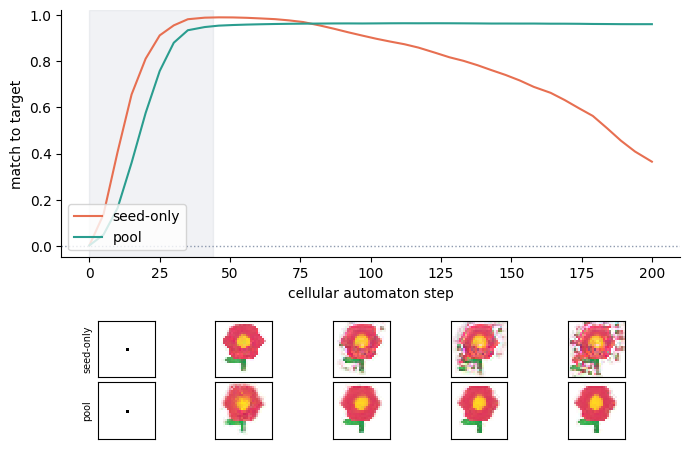
cellular automaton — A grid of cells updated in parallel by one rule that reads only a local neighbourhood. No cell sees the whole grid, and there is no step anywhere that considers it.
at step 200: seed-only 0.292 · pool 0.977
gap of 0.684
So one rule stays and the other does not, and nothing in either objective ever mentioned staying. That is worth being precise about, because the tempting summary — that comes along for free with growth — is the one thing this run rules out. Both rules grew. One of them was additionally trained on states that were already grown, and on a few that had holes in them, and that is where persistence came from.
Which sets up the last question. A rule that holds its shape is not obviously a rule that can rebuild it: staying still and coming back are different behaviours, and only one of them was ever in the training distribution. Cut the flower in half and find out.
Four panels: the target, the grown flower, the flower with half the grid zeroed, and the same state left to run. Every channel is erased in the cut, hidden ones included, so there is no surviving scaffold to rebuild from — the region has to be re-entered across the boundary, one cell per step. This is not image restoration from what survived; it is rebuilding from the boundary inward. Check the leaf specifically. It was only ever on the erased side, so it cannot be mirrored back from anywhere; if it returns on the correct side, the rule reconstructed it rather than copying it.
HEAL_STEPS = env.cfg["healSteps"]


def ar(text: str) -> str:
    """Join Arabic letters into their connected forms, then reorder for LTR drawing."""
    return get_display(arabic_reshaper.reshape(text))


def erase_half(state: torch.Tensor, side: str) -> torch.Tensor:
    """Zero one half of the grid, every channel — hidden ones included.

    Zeroing only RGBA would leave the rule's own signalling channels intact and
    the grid would rebuild from a scaffold that is still standing. Taking every
    channel is what makes this an ablation rather than a repaint.
    """
    cut = state.clone()
    half = GRID // 2
    if side == "left":
        cut[:, :, :, :half] = 0.0
    elif side == "right":
        cut[:, :, :, half:] = 0.0
    elif side == "top":
        cut[:, :, :half, :] = 0.0
    else:
        cut[:, :, half:, :] = 0.0
    return cut


torch.manual_seed(env.cfg["seed"])
stable, _ = roll_out(pool_rule, make_seed(1), GROW_STEPS)
stable_match = match(stable)

wounded = erase_half(stable, "left")
damaged_match = match(wounded)

healed, _ = roll_out(pool_rule, wounded, HEAL_STEPS)
healed_match = match(healed)
recovery = healed_match - damaged_match

fig, axes = plt.subplots(1, 4, figsize=(9, 2.6))
for axis, (state, label_en, label_ar) in zip(
    axes,
    (
        (target.unsqueeze(0), "target", "الهدف"),
        (stable, "grown", "بعد النمو"),
        (wounded, "half erased", "بعد المحو"),
        (healed, "healed", "بعد الترميم"),
    ),
):
    axis.imshow(to_rgb(state), interpolation="nearest")
    axis.set_title(ar(label_ar) if env.lang == "ar" else label_en, fontsize=9)
    axis.axis("off")
fig.tight_layout()
plt.show()

env.explain("regeneration")
if env.lang == "ar":
    print(
        f"بعد النمو {stable_match:.3f} · بعد المحو {damaged_match:.3f} "
        f"· بعد الترميم {healed_match:.3f}"
    )
    print(f"استعادت {recovery:.3f} خلال {HEAL_STEPS} خطوة")
else:
    print(f"grown {stable_match:.3f} · erased {damaged_match:.3f} · healed {healed_match:.3f}")
    print(f"recovered {recovery:.3f} in {HEAL_STEPS} steps")
regeneration — Returning to the target after part of the state is destroyed. Distinct from growth, and — as this run shows — not something a rule acquires just by being good at growing.
grown 0.971 · erased 0.457 · healed 0.765
recovered 0.309 in 96 steps
Exercise
Nothing retrains here. The rule is fixed and you are choosing what to do to a finished flower.
Pick a side to erase and a number of steps to allow. Then look for the boundary of what this rule can do, which is more interesting than the recovery number: find a cut it comes back from completely, and a cut it cannot come back from at all. The second one exists. When you find it, the question to answer is not whether the rule is weak but what the cut took away — the rule only ever moves information one cell per step, outward from something already alive.
# YOUR TURN.
#
# Nothing retrains here. The rule is fixed; you are choosing what to do to a
# grown flower and watching the same rule respond.
#
# SIDE     "left" | "right" | "top" | "bottom"
# STEPS    how long to let it run afterwards
#
# The defaults sit away from the graded run on purpose — a knob whose default
# happens to reproduce the checked number teaches nothing about the knob.
#
# Two questions worth more than the number: does the LEAF come back on the
# correct side when you erase the side it was on, and is there a side whose
# removal the rule cannot come back from at all?
SIDE = "bottom"
STEPS = HEAL_STEPS

torch.manual_seed(env.cfg["seed"])
your_stable, _ = roll_out(pool_rule, make_seed(1), GROW_STEPS)
your_wounded = erase_half(your_stable, SIDE)
your_healed, _ = roll_out(pool_rule, your_wounded, STEPS)

fig, axes = plt.subplots(1, 3, figsize=(6.6, 2.5))
for axis, state in zip(axes, (your_stable, your_wounded, your_healed)):
    axis.imshow(to_rgb(state), interpolation="nearest")
    axis.axis("off")
fig.tight_layout()
plt.show()

if env.lang == "ar":
    # SIDE stays an ASCII identifier value, but dropping it raw into Arabic
    # prose reverses the reading order around it. Named here instead.
    sides_ar = {"left": "اليسار", "right": "اليمين", "top": "الأعلى", "bottom": "الأسفل"}
    print(
        f"محو {sides_ar.get(SIDE, SIDE)} · بعد المحو {match(your_wounded):.3f} "
        f"· بعد {STEPS} خطوة {match(your_healed):.3f}"
    )
else:
    print(
        f"erased {SIDE} · after damage {match(your_wounded):.3f} · after {STEPS} steps {match(your_healed):.3f}"
)A hint is available in the notebook — env.hint(3)
The control is checked first and deliberately. The finding is that the seed-only rule arrives and then leaves, and a rule that never arrived never left — so without that check the other three numbers could be describing two rules that simply both failed to learn the task.
# The control goes FIRST and on purpose. If the seed-only rule never reached
# the flower at the horizon it was trained through, then it did not overshoot
# the flower either, and every comparison below would be between two rules that
# both simply failed to learn the task. If this check fails the answer is more
# training steps, never a lower bar.
naive_grows_ok = env.check("naive-grows", naive_match_trained)
target_match_ok = env.check("target-match", pool_match)
# Keyed on the pool rule's OWN match at the horizon, not on the gap between
# the two rules. Across two runs the gap moved 8.45 -> 0.63 while this number
# moved 0.81 -> 0.86: the gap's magnitude is mostly a measure of how badly the
# loser happens to fail on a given seed, which is not what the check is for.
# The gap is still captured and still quoted, as evidence rather than as a bar.
persists_ok = env.check("persists", pool_match_long)
recovers_ok = env.check("recovers", recovery)✓ Seed-only rule's match to the target at the horizon it was trained through: 0.9873 (needs ≥ 0.85)
✓ Pool-trained rule's match to the target, grown from a single cell: 0.9709 (needs ≥ 0.75)
✓ Pool-trained rule's match to the target, far past the horizon it was trained through: 0.9769 (needs ≥ 0.7)
✓ Match regained after half the grid is erased: 0.3089 (needs ≥ 0.2)receipt = env.receipt()Workshop complete.
Completion code: AZ-██████████
Paste it on the workshop's page on Azimuth to record it.Terms in this workshop
- Cellular Automatonالآلة الخلوية
- Morphogenesisالتشكل الحيوي
- Update Ruleقاعدة التحديث
- Sample Poolمخزون العينات
- Regenerationالتجدد